Showing posts with label drama. Show all posts

Saturday, 20 August 2011

New version of 3rd Ring Out opens in Edinburgh


One of the winners of the 2010 Tipping Point commissions, 3rd Ring Out (which we blogged here and here) has now opened at the Grassmarket in Edinburgh. Its director Zoë Svendsen says:

We've now got a 'strategy' cell as well as a 'simulation' cell - we've split the use of the two containers into (1) short term crisis in a climate-changed future, under a business -as-usual scenario (which is the same format as last year but now about the Suffolk coastline); and (2) long term alternative futures about the city we are in, generated by ideas gathered from the public and others.


18-28 August, Edinburgh Fringe Festival
In the bright orange shipping containers. Grassmarket
Pleasance Courtyard
60 Pleasance
Phone 0131 556 6560

Other shows of interest at the Edinburgh Fringe blogged here
Zoë Svendsen's metaphor for sustainability on this blog and the Ashden DIrectory
more ...

Monday, 1 August 2011

What is it that art could do for the environment?

Photo: Green Alliance
Kellie Payne reports on the Green Alliance's summer debate about the arts and the environment.

For their summer reception, the environmental think tank Green Alliance hosted an evening of opera and debate at the Royal Opera House. In conjunction with The Opera Group, the evening began with a fifteen minute excerpt of Luke Bedford‘s new opera Seven Angels, is inspired by Milton’s Paradise Lost and has environmental degradation as its theme.

Following the opera taster, there was a panel discussion entitled ‘What have the arts ever done for the environment? The panel included a mix of representatives from the worlds of policy, the arts and academia. It was chaired by Julie’s Bicycle’s Alison Tickell, and panellists included: The Southbank Centre artistic director, Jude Kelly, RSA chief executive Matthew Taylor, Arcola Theatre executive director Ben Todd, the sculptor Peter Randall-Page and David Frame, fellow of Oxford University. In her introduction, Tickell indicated that the Seven Angels was one among a crop of new work being made by British artists that addressed nature or the environment among those artists she listed were Antony Gormley, Ian McEwan, Jay Griffiths.

One of the main themes of the evening was an attempt in the discussion to answer the general question of what it is that art can do for the environment. It was generally agreed that one of the strengths of art was that it was well equipped to deal with the complexities that many environmental issues such as climate change raise. Matthew Taylor saying that art should be one of the many interventions required to tackle climate change.

One of the most eloquent responses came from the scholar, David Frame, who highlighted art’s ability to deal with complexity and tension. He felt that as climate change and environmental problems are so complex in nature, with for instance climate change knowledge dispersed amongst many specialists without a graspable whole. He said that the arts community has ‘a unique ability to convey complexity, delicacy, and beauty and among the things you can do is you don’t need to simplify...’

He pointed to the deficits in mediums such as Twitter or the 1,000 word Op Ed piece and contrasted this with the length of a novel or a film where he said ‘the possibilities for the ideas you can upload to people is phenomenal.’ This type of medium he said was also more able to cope with uncertainties. ‘You leave interpretation open which isn’t considered acceptable in other forms and I think that in doing so you can bring out tensions between these parallel values’.

Changing values seemed to be one of the key roles identified for art that emerged from the discussion. Alison said she has observed what she describes as a ‘palpable’ shift in values taking place rapidly and for her ‘the arts do have a role to play in reflecting and shaping and engaging with those values.’ While Matthew didn’t agree with Alison the extent to which values have already changed in the positive direction Alison described. In fact, he warned that during this current time of disturbance there is a clear dissatisfaction with current values but which way public opinion would turn was not decided. He said the dissatisfaction could lead in two ways, and not necessarily in a progressive direction he lamented that ‘it can go in a dangerous direction as well.’

The question of how politics should be addressed raised differing opinions. Jude Kelly began by announcing she ‘didn’t mind a bit of bad art’ provided that art had some sort of message. She went on to say, ‘I don’t think it’s a hanging offence to produce a message’ However if it’s not particularly interesting it might ‘bore me after awhile’. Further, ‘I don’t mind artists having a go. I really dislike the idea that artists shouldn’t be allowed to take centre stage to comment on things.

While Peter conceded that there was ‘nothing wrong with political art’, for him it was less the politics which art was best equipped to address. He was more of the mind that art’s quality was that it didn’t have a direct ‘purpose’ that it was its intrinsic values alone that made art great. He believes that ‘arts are not well placed to (do) issue based lobbying’ contrasting what he finds often to be the pragmatism of the environmental movement with the arts ability to nourish imagination and the spirit in the way the natural world does. ‘I think the role that I feel for the arts in environmentalism is that it... reminds us that we’re not all bad. If we only feel negative it’s impossible for us to move forward and remove this exclusively pragmatic approach to looking after the world.’

Matthew wanted to introduce a third way of thinking about the issue agreeing that art shouldn’t attempt to kick us around the head. However, he felt art could ‘challenge people to live differently and value things in slightly different ways.’ Providing a vision of how ‘a different, deeper kind of understanding about what makes life worth living and what it is society wants to be.’ This task he felt art was ‘incredibly well suited’. That is, ‘art is there to explicitly to get you to think about what the good life is.’ He concluded this thought saying ‘art shouldn’t be ashamed to say that art is here to help you rethink what our values are and I don’t think that requires you to revert to a kind of crude placard waving.’

In addition to the discussion about art and politics, the panel also touched on the controversial issue of artists lifestyles and the high carbon footprint of the arts. The general attitude on the panel was that this shouldn’t be paid as much attention as it has been. Jude Kelly saying that this arts requires face-to-face interactions and not allowing artists to fly amounts to a cultural boycott. But Matthew Taylor thought artists should be accountable, and if they want to have influence on others they have to take account of their own actions.
Increased collaboration amongst artists was encouraged, suggesting that the problem of the environment is one that artists should attempt to do together. Arts organisations such as Cape Farewell and Tipping Point were highlighted as doing exceptional work, helping to inform artists of climate change and bringing the topic to their consciousness.

It was edifying to see an organisation such as the Green Alliance, who normally deals with more policy related issues such as building a sustainable economy, investigating climate and energy futures, designing out waste and political leadership to host a conversation with the arts community. A cursory glance over badges of audience members saw representatives from business and policy, including the Department for Energy and Climate Change and The Environment Agency, so the wider these issues can be encountered and discussed the better. It’s time the arts community made it’s voice heard in the conversation about climate change. Peter concluded well, stating that it is artists who need to create metaphors and narratives which make it possible to go into the future.

Pic: The speakers (l-r): Jude Kelly, Matthew Taylor, Dr David Frame, Ben Todd, Peter Randall-Page and Alison Tickell (photo: Paul West) more ...

Tuesday, 28 June 2011

Physical theatre that works on many levels


Bradon Smith visits the Greenwich and Docklands Festival to see Wired Aerial Theatre's latest production, one of this year's TippingPoint commissions

As the World Tipped is a spectacular piece, written and directed by Nigel Jamieson, lying somewhere on the joins between theatre, cinema and circus arts. It opens in a bureaucratic setting with a roll-call of extinct species. An official takes a sheet of paper, reads the name of the lost species, stamps it and transfers it to another pile. Around him others bring the pieces of paper, at first singly and then in boxes, until they tower around him. As the boxes obscure his desk, news comes through of the COP15 summit, and the scene moves to Copenhagen.

And with that, the narrative of the piece is pretty much done. Because as we listen to excerpts from speeches from COP15 by Brown, Obama, and representatives of the Alliance of Small Island States; and as the negotiators struggle to reach an agreement; and as the characters on stage become increasingly exasperated as successive drafts are rejected; as this happens, the stage begins to tip towards the audience.

First boxes and papers begin to slide, then desks, then performers, who struggle to scramble up the inclining stage. As the stage becomes steeper, climbing becomes more difficult – some of the actors have reached the top and are hanging precariously on to the edge, but others are having difficulty. And the audience reacts with a combination of pleasure at the spectacle, cheering the performers in the manner of a pantomime, but with also a suggestion of anxiety, a sort of vicarious vertigo.

Hoisted by a crane, the stage becomes a vertical stage-screen; and as images are projected on to it, the performers – now wired to harnesses – tumble down the face of it and, in the vignettes that follow, interact with the images in a way that is convincing and compelling. As the text of draft negotiations scrolls down the screen, for example, the performers run, leaping the paragraph breaks; or as we watch scenes of floods, the actors are bounced around by the roiling water.

The movement of the performers across the screen is achieved by attaching them via pullies to operators who scamper up and down two ladders running along the sides of the screen-stage. The hanging performers are deftly manipulated, so that they appear immersed in the scene projected behind them. In one nice moment we see a girl scampering up the inclines of a graph projected on the screen behind her (CO2? GDP?) and sliding down the declines, with her operator administering a jolt as she 'hits' the bottom of each downward trend.

One result of this mechanism is that the performers themselves have only limited control over their own movements, aiding the illusion. But it is also an important part of the piece's visual metaphor – the characters appear at the mercy of the environment staged or screened behind them: at first, the failure of the Copenhagen negotiations, and then the unstable climate we have created.

As the World Tipped is a spectacle, but it also reveals evidence of a depth to its thinking. In one scene, a character is consumed by fire in a rather clichéd post-apocalyptic landscape. As she hangs limply, this scene is in turn swallowed by a TV screen, leaving the performer suspended in the frame. The moment suggests, perhaps, an awareness of the inadequacy of this very form of dramatic representation.

Technically the performance is dramatic – but the piece achieves a range of tone, with moments of levity and real poignancy. It also hints at issues beyond that of climate change. If I have a criticism, it is of a few projected images of sad, subcontinental faces staring in to the camera – a couple of moments felt like they were performed against the backdrop of an Oxfam poster campaign. In line with this was the ending, in which the performers 'tear' away the “The End” screen to reveal a screen asking us to “Demand Change Now”, which felt more heavy-handed than the preceding piece.

Otherwise, this is a great piece of physical theatre: dramatic, entertaining and with a conceit that works on many levels and from many angles. Especially the vertical.

Bradon Smith is a research associate in the Geography department at the Open University and AHRC Climate Change Research Fellow at the Department for Culture, Media and Sport
more ...

Thursday, 23 June 2011

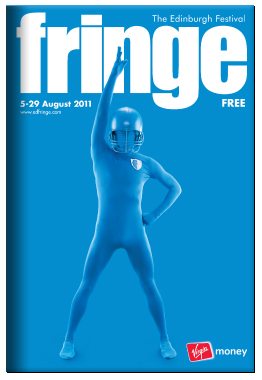
This year's Edinburgh Fringe takes green ideas into new areas

Every year we comb through the Edinburgh Festival Fringe programme, speculating on whether productions may have a connection with environmental themes or climate change. This year seems different to previous years.

There are half a dozen theatre shows that clearly have environmentalist themes: mountain-top removal mining; allotments; restrictions in response to climate change (a comedy about socks); and protests against nuclear energy (an adaptation of Lysistrata).

There are shows about human relations with animals, about bullfighting, vegetarianism, our fear of the wolf, and the return of a show taking place in the Edinburgh Zoo. There's also a return of The Man Who Planted Trees. Each year has a share of Frankensteins and Fausts, and shows about Darwin, Francis of Assisi and Galileo.

But there are more shows this year than previously that connect indirectly with environmental themes. Many shows are set in a post-catastrophe world (in previous years, the environmental catastrophe was usually still on its way), or set in the woods, or in dystopian cities.

Other shows relate an environmental situation to another aspect of life: the flooding of overwhelming human emotions is related to the flooding of rivers; a search for a longed-for grandfather is related to a search for a forest. And looking even more widely, we've included productions about capitalism, poverty and urbanisation. This dispersal of environmental ideas into new dramatic territories seems to be a notable change in what this year's Fringe offers.

The number of shows on at the Edinburgh Fringe that we list in the Ashden Directory is still a very small part of the Fringe overall, whose most popular themes remain World War II, the Holocaust, sex, relationships, and personal identity. more ...

Thursday, 16 June 2011

new on our newspage

The Greening Design Forum, hosted by the Society for British Theatre Designers, will discuss sustainability in the theatre industry, at the Old Vic Tunnels, London, 22 June.

The morning after the solstice, 22 June, in Glasgow, a DIY chorus will sing to the sunrise.

A conference on the conflicts over goals and values arising in conservation and in the maintenance of biodiversity has sponsored four artists' residencies to explore conflicts and their contexts. The organisers are the Aberdeen Centre for Environmental Sustainability, and the artists are Dalziel and Scullion, using film and sculpture; Helen Denerley, who re-uses scrap metal to create sculptures inspired by the animal world; Huw Warren, pianist and composer; and Esther Woolfson, writer.

New productions:
A Funeral for Lost Species by Feral Theatre, a TippingPoint commission, comes to the Green Man Festival in Wales, in August.

My Last Car, by 509 Theatre, again a TippingPoint commission, will be at the Warwick Arts Centre in October.

University College Falmouth is offering funded PhD's, some of which have an environment and arts connection. Interviews early July. more ...

Wednesday, 1 June 2011

new on our newspage

Artsadmin’s Two Degrees 2011 Festival, Art & Activism, Climate & Cuts, runs from 12 – 18 June in London, with artist-led interventions and events on the themes of government cuts, global protest and activism, and the growth of alternative solutions to the climate crisis. There’s the chance to eat American Signal Crayfish caught from the River Thames, a trail of bicycling events between Artsadmin’s Toynbee Studios and Arcola Theatre, and other events, films, excursions, including A Good Climate for Business, Future Editions, Potion, Haircut Before the Party, Paths Through Utopias.

Our Current Climate, 18 June, closes Two Degrees with a day of talks, workshops, performances, interventions and walks with artists from the festival and Encounters, UK Uncut and the Yes Men.
The event will be asking how exactly are the climate and the funding cuts linked, and how can we use art and activism to change our current climate?

Manchester International Festival has two different events touching on the environment, Björk’s Biophilia show, and the launch of a three-year project to construct a vertical farm in a disused tower block.

We list those summer music festivals that have environmental themes, or are working towards a low-carbon event.

New productions coming up in June include Harmonic Fields (Lakes Alive), As the World Tipped (Nigel Jamieson and Wired Aerial Theatre, a TippingPoint/Without Walls commission) and SEVEN ANGELS (The Opera Group, ROH2 and Tramway).

Other events: University of the Trees holds an Open Day on 5 June, and a public talk by Shelley Sacks on 11 June at the Centre for Contemporary Art and the Natural World, Devon.
more ...

Tuesday, 31 May 2011

makes you gulp, makes you think

The Stage reviews As The World Tipped, one of the winners of this year's TippingPoint commissions. The reviewer, Mark Shenton, says the show is very timely indeed.

"Part very physical performance and part film, as aerial acrobats are suspended and crawl over a giant vertical screen that the stage becomes, and are dwarfed by the huge filmed images projected around them, this outdoor show is a lot more than mere spectacle. It does that rare thing - it makes you gulp with astonishment, but also think."


Five-minute YouTube clip here.
more ...

Monday, 28 February 2011

classics and headlines

The Guardian theatre blog links to some recent posts we've done about Oedipus, Faust and Frankenstein.

the best art maintains its true relevance not by reacting quickly to the headlines, but by probing deeply into the fundamental things that make us human more ...

Friday, 18 February 2011

what oedipus rex tells us about climate change

In his column, 'Nature Notes' in the Independent, Michael McCarthy argues that the particular way in which we think about the major problems that confront us makes us incapable of grasping their size.

The principal fault of Oedipus in Sophocles' Oedipus Rex, remember, was not that he murdered his father and married his mother; those were incidentals of his fate. His real fault was that he thought he knew everything, he had answered the riddle of the Sphinx, he was Mr Clever. The Gods showed him that he wasn't (and in the greatest of all tragic ironies, he puts out his eyes to punish himself for having been blind to his true situation, which now he can see).

In the modern consensus, in liberal secular humanism, this spiritual view of Man of having limits, of not being able to do everything he chooses, and of potentially being a problem creature, is missing entirely. There is no trace of it whatsoever.


pic: Ralph Fiennes as Oedipus and Clare Higgins as his mother/wife, Jocasta.

See also
What Frankenstein and Titania tell us about climate change
The Greek Divide
Leave it the way we got it 
More hubris
Adrenaline on the cornflakes
The Greeks had a word for it
more ...

Thursday, 17 February 2011

what frankenstein and titania tell us about climate change


A few days ago, commenting on the themes in Greenland and The Heretic, this blog said:

At the moment it feels as if playwrights are reacting to the journalistic noise around climate change. When the deeper ideas do emerge in plays, and these ideas inform the actions of the characters, the immediate subject of the play may not even be climate change.

What that post might have added, is that many themes that relate to climate change already exist in other plays. In his new blog, Joe Smith, Senior Lecturer in Environment at The Open University, finds that the National's production of Frankenstein is more thought-provoking about climate change than Greenland.

there is a Romantic anti-industrialisation/anti-urbanisation strand which runs through environmentalism from day 1. But there are also strands in recent discourses of climate change ‘solutions’ that are in thrall to science and technology’s apparent invincibility and adaptability. Hence the arch modernists who were formed in the whiteheatoftechnology environment of the 1950s and 1960s are happy to contemplate immense geo-engineering experiments and massive expansion of nuclear power – Science discovered this problem and Science will solve it.

After this blog had tweeted that link, Susannah Clapp, the Observer's theatre critic and author of With Chatwin (highly recommended), replied by suggesting A Midsummer Night's Dream and Titania's "the seasons alter" speech.

In Act 11, Scene i, Titania describes how through "this distemperature" we see:

The seasons alter: the spring, the summer,
The childing autumn, angry winter, change
Their wonted liveries, and the mazed world,
By their increase, now knows not which is which


(In 2002 Futerra made a short film, The Seasons Alter, based on this speech.)

See also: Mark Rylance picks climate change lines from King Lear, All's Well That Ends Well, Two Gentleman of Verona and King Lear and Bill Moyers picks two lines from King Lear.

See also: George Monbiot finds Dr Faustus the key text.

pic: Jonny Lee Miller and Benedict Cumberbatch in the NT's Frankenstein more ...

Wednesday, 16 February 2011

commissions divide between those who have a track record in this area and those who don't

Wallace Heim, co-editor of the Ashden Directory, assesses the latest TippingPoint commissions announced last night

In the mix of projects awarded TippingPoint commissions, it’s striking how most of the companies and artists do not have a history of working with environmental themes.

Some do: Feral Theatre; Vicky Long and Tim Sutton; and Craig Vear. But others seem to be coming to the challenges of this commission - to stimulate the imaginative thinking necessary to navigate a world shaped by climate change – for the first time.

This could be an argument for how, once funding is made available, productions will follow. This could also reflect how any artistic practice –  aerial spectacles, intimate vigils, composed music, sound art, the crafting of objects, place-based performance – offers a particular way-in to understanding a changing climate.

The expectations for these projects is high. The example of Greenland at the National Theatre shows how a sudden education in climate change does not necessarily produce a viable play; the lessons of a decade of environmental performance weren't learned.

An ideal would be if these TippingPoint commissions can bring fresh and nuanced ideas about climate change to their own inventive practices.

Full details on the winning commissions on the Ashden Directory. more ...

Friday, 11 February 2011

two very different plays about climate change share some things in common

"Climate change drama is the new growth industry", writes Michael Billington in today's Guardian. Well, about bloody time.

Greenland opened at the National on 1 February, and Richard Bean's The Heretic opened at the Royal Court last night. They couldn't be more different.

Greenland has four authors, multiple storylines and an anxious desire to reflect the range of positions people have taken on the subject. The Heretic is the work of one author, its science is about as plausible as its plot-line, but it's got some great characters and some very funny jokes.

If the two plays are similar at all, it's in what they don't achieve.

Neither play catches the intensity of feeling that surrounds these issues in the developing world. They are Eurocentric, when understanding how one half of the world impacts on the other is central to the subject.

Nor does either play give a genuine sense that the news contained within the IPCC reports changes our view of the world, and our place in it. The reports do this, and they do it as profoundly as Galileo stating that the earth revolves around the sun or Darwin stating that all species of life have a common ancestry.

These are ideas that can't be speedily researched by playwrights. They raise large philosophical and ethical questions. (The first report was published in 1990, so we've had 20 years to think about it.) But the ideas have to be lived with, experienced and internalised.

At the moment it feels as if playwrights are reacting to the journalistic noise around climate change. When the deeper ideas do emerge in plays, and these ideas inform the actions of the characters, the immediate subject of the play may not even be climate change.

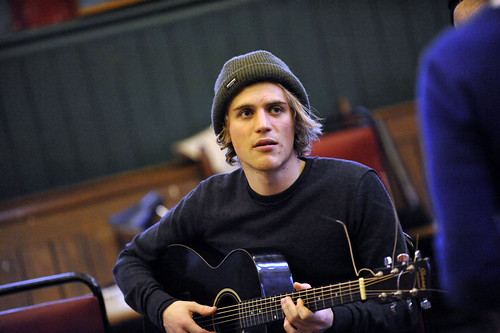
Pic: Johnny Flynn in rehearsals for The Heretic. more ...

Thursday, 10 February 2011

one planet discusses climate change plays

This blogger is on the World Service's One Planet today discussing plays about climate change. There's also a contribution from Steve Waters, and an interview with Ben Power, Greenland's dramaturg, who says: "We're trying to find a different way to talk about this thing." more ...

Tuesday, 8 February 2011

david hare's documentary subjects

David Hare on writing documentary dramas.

“I am never comfortable until I can understand a way of it being more than the subject matter.”

"When I go to see a film like The Social Network, then I feel a kinship, I feel they are doing exactly what I am trying to do, which is to make a modern myth out of quasi documentary theatre. But in the theatre, I feel incredibly lonely.”
more ...

Wednesday, 2 February 2011

what the twitterverse thinks of greenland

@Paul_Griffiths_ Feeling all green and depressed after @nationaltheatre #Greenland; on my way home to recycle, buy some wellies and write my will!

@ktlovestheatre National last night for #Greenland. Patronising claptrap! Script? Mali? Bamako? Eco-lesbians? UN? Rubbish! Like poor quality TIE. Miss it!

@miriamgillinson Is it bad that climate change feels like old news? Let's hope #Greenland @NationalTheatre changes my mind.

@pat_hobby @jackthorne did you write the toilet roll monologue in #greenland ? The first play to ever revolutionise the audience's wiping technique?

@peterlacy #Greenland new play at #National Theatre: strength/weakness doesn't tie story together in simple message. Frustrating but true of real event

@cathradojcin Went to see #Greenland at @NationalTheatre - v compelling & exciting look at climate change & all it's issues &complexities.Fully recommend

@shesaws Home from #greenland at the NT. Still making up my mind about how the climate change argument was made, but it certainly generates debate.

@tiina_hei Some excellent polar bear characterisation, rainfalls and snow storms at @NationalTheatre this evening. #Greenland more ...

Wednesday, 26 January 2011

at greenland, audiences get to have their say ahead of critics

The National Theatre's play about climate change, Greenland, had its first preview last night. The critics don't get to see the play till 1st February, but audience members, leaving the show last night, had a chance to express their views almost immediately.

In the Lyttelton foyer, there's a Talkaoke table, billed as a mobile talk show, where audience members take a seat, grab the microphone, and share their views on Greenland and climate change. (The pic shows a similar Talkaoke event at the Dana Centre.)

For those interested in other views still, a season of Greenland events includes talks by the four Greenland playwrights, and four well-known voices on climate change, Bjorn Lomborg, Tim Flannery, Nigel Lawson and David King. more ...

Thursday, 20 January 2011

from no plays about climate change to three in a month

It was only a couple of years ago that this blog was writing about why theatres don't touch climate change. It seemed, at the time, as if there was something about theatre, or the way people conceived of mainstream theatre, that made the subject almost impossible to treat. This was part of a more general avoidance of the environment as a subject for the performing arts. The Ashden Directory had been launched, back in 2000, as a way of following and encouraging those works which did engage with this subject.

But now things are changing. Eighteen months ago there was finally, a good play about climate change.  It was also possible to see in the works, for instance, of Wallace Shawn and Andrew Bovell the green shoots of climate change theatre.

Fast forward to January 2011, and this month alone three climate change plays will open in London - Greenland at the National, The Heretic at the Royal Court, and Water at the Tricycle.

Why is this important? Because climate change alters the way we think about our lives. The news contained within the various IPCC reports will be as influential, as paradigm-shifting, on the way we see ourselves as Darwin's Origin of Species. It is, ultimately, a question of values and relationships. As such, it is a natural subject for theatre.

But new plays don't open in a vacuum. For them to succeed, there needs to be a lively engaged audience that has some sense of what is at stake. That's why we have also been involved with the Open University in producing a new series of podcasts that puts cultural work around climate change in perspective.

The podcasts bring together 17 artists, activists, writers, film-makers, scientists, entrepreneurs and academics, including comedian Marcus Brigstocke, choreographer Siobhan Davies, BBC environment analyst Roger Harrabin, architect Carolyn Steele and Mike Hulme, author of Why We Disagree About Climate Change.

Radio 4's Quentin Cooper chairs these four 'Mediating Change' discussions which cover the history, publics, anatomy and futures of cultural responses to climate change. The podcasts are now available to download from iTunesU.
more ...

Thursday, 13 January 2011

what scientists believe in

The short two-sentence quote that accompanies the publicity for Richard Bean's The Heretic at the Royal Court runs: “I’m a scientist. I don’t ‘believe’ in anything.”

I prefer the view of the female scientist in Kim Stanley Robinson's Forty Signs of Rain. When pressed about what she actually believes in, Anna replies the double blind study. more ...

Wednesday, 15 December 2010

four podcasts on culture and climate change now online


A new series of four podcasts on Culture and Climate Change is now online at iTunes U. The discussions bring together artists, writers, film-makers, scientists, academics and journalists with a comedian, a choreographer, a campaigner, and an entrepreneur.

The Mediating Change series is hosted by Quentin Cooper and contributors include Tim Smit, Marcus Brigstocke, Siobhan Davies (see pic), Roger Harrabin, Joe Smith and two of the Ashden Directory's editors, Wallace Heim and Robert Butler.

More details here.

The producer, Vicky Long, says:

Cultural activity in this area is gathering real momentum, with 'Greenland' opening at the National Theatre and 'The Heretic' opening at the Royal Court early next year. We feel it’s vital a critical framework is developed alongside this emerging work.

This series represents a first sustained exploration of culture and climate change in a publicly-available broadcast-quality format.


See also: Tipping Point launches first of four discussions
Tim Smit and Marcus Brigstocke join debate on popular culture and climate change

photo: from Endangered Species (2008), choreography by Siobhan Davies.
photo credit: Vicky Long more ...

Tuesday, 7 December 2010

new york meets norway

Funny and poignant eco-fable from New York theatre collective Wakka Wakka and Nordland Visual Theatre from Stamsund, Norway. more ...