Showing posts with label climate change. Show all posts

Tuesday, 11 December 2012

The tide could turn with 'Ten Billion'

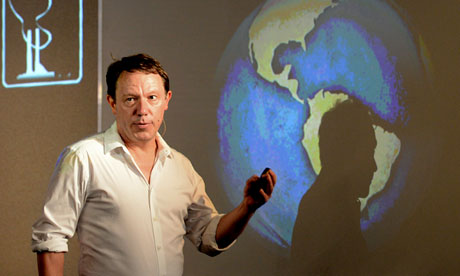
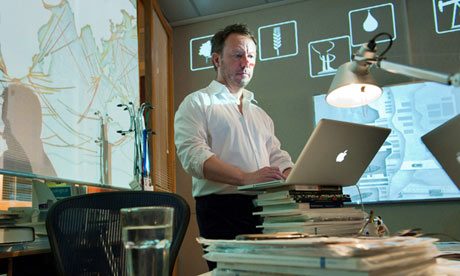
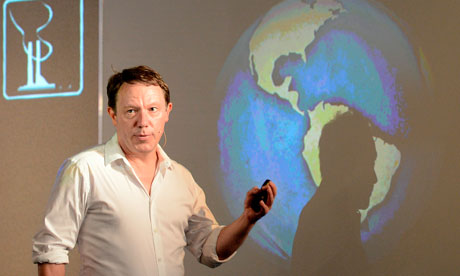
Stephen Emmott in Ten Billion
Wallace Heim writes:

Theatre critic Kate Abbott in today's Guardian joins Michael Billington in reporting a life-changing experience watching Ten Billion at the Royal Court.

Like the facts that Stephen Emmott presented, Abbott can recite the well-polished instructions to "help us out of this hole":

"Never buying a car, iPod, or cotton T-shirt again … stopping our addiction to fossil fuels, starting a mass-desalination programme, building green energy power points on every strip of land, harnessing every scrap of wind, and every turn of the tide …"

But one change is missing. What about demanding that theatre itself changes? What about demanding that mainstream theatre no longer turns away from the compelling emotional, moral and intellectual questions of how humans can continue to live in a time of climate instability? Theatre is more than science, more than facts, more than an instruction manual. What about demanding that theatre takes on its full life-changing role, somewhere between fiction and fact, and becomes the place where audiences wrestle with their future?

See 'Ten Billion' from another side.
more ...

Friday, 7 December 2012

'Ten Billion' from another side

Wallace Heim writes:

Michael Billington, in his nomination of Ten Billion as the best theatre event of 2012, claims that all the people he knows who saw the production found it life-changing. From my unscientific poll of the dozen people I know who saw the production, including myself, it’s possible we were in a different theatre. The lecture was well-crafted, the production tight, but the event was neither moving, informative or motivating. It was ‘old news’, a ‘first-year introductory lecture’, ‘Al Gore without the cherry picker’.

Billington’s lauding of the production is encouraging. That he, and others, were deeply affected is even more so, although one wonders what he has avoided reading or seeing for the past 20 years if the information presented was shocking. But Billington finds that it is not merely the accumulation of statistics, but the presence - the performance - of Stephen Emmott, the verifiable scientist, the speaker with a creditable reputation outside the theatre, that gave the production its urgency.

For this audience, the fluid realm of belief and disbelief that makes theatre work had to break down for the shock of climate instability to be heard. At the same time, the very theatrical occasion of sitting in that darkened room redolent of emotions of past productions, listening to another human speak, heightened any effect.

Asking again of those who found the production lacking, I found each person had, in their experience outside the theatre, at least one, if not many moments when the numbers add up, when the terror hits, when someone trusted speaks about a future irreconcilable with what one could bear. These events can be motivating and if Ten Billion provided that for some, then theatre’s role as educator has been met.

But if you’ve already had that experience, theatre is where you want to go to understand it, and a collocation of facts will not do that. This is a far more confused territory, requiring human imagination and many avenues of intelligence, deliberation, conflict and consent. It requires doing something like the processes of science, itself – its questioning and cross-questioning, experimentation, doubt and informed agreement.

Theatre may not be the place to present firm courses of action; Emmott’s advice to get a gun falls especially short. Conventional forms of theatre may, or may not, be adequate to the combination of reality and fiction that understanding climate change demands. But theatre, or something like it, continues to be a place where collectively, humans find a way through. There will continue to be many kinds of productions for many kinds of audiences. The hunger for a theatre by the audience that gets the facts but wants more continues to be strong. 
more ...

Thursday, 6 December 2012

'Ten Billion' changes Billington

Stephen Emmott in Ten Billion
Wallace Heim writes:

Michael Billington in today's Guardian nominates Ten Billion as the 'most momentous theatrical performance' of 2012. The show was a lecture by Stephen Emmott, at the Royal Court Theatre Upstairs, on the consequences of human overpopulation and climate change.

Billington writes:

'I came out shaking with fear, but also moved by theatre's capacity to confront the emergency facing our planet.

'This was theatre doing what it does best: confronting us with unpalatable facts about our very existence. This doesn't mean that there is no room for invented stories or that King Lear and The Lion King have suddenly become redundant. But Ten Billion, directed by Katie Mitchell, shocked us into a new awareness of the future, and even the existing present, with ecosystems being destroyed, the atmosphere polluted, temperatures rising and a billion people facing water shortages.

'I don't know a single person who saw it who didn't feel it was a life-changing experience. If enough people, especially those in positions of power, could see Emmott's lecture, it might, just might, help to save our planet from destruction'.
more ...

Friday, 5 October 2012

the family and the world heat up in Nick Payne's play

Photo: Joan Marcus
Kellie Gutman writes:

If There Is I Haven't Found it Yet, with Brian O'Byrne and Jake Gyllenhaal, opened in New York's Roundabout Theatre in September and runs through 25 November.  It was written by Nick Payne, and inspired by his reading of Heat by George Monbiot, about decreasing one's carbon footprint.  Payne saw that many authors of environmentally-themed books had dedicated them to their children, and it gave him the idea of a father trying to save the planet in order to make the world a better place for his children, and beyond.  But the father is so wrapped up in his work that he fails to notice the problems within his own family.  The New York Times review is here.

Artistic director Todd Haimes writes:

On one level, we are watching a domestic drama play about a mother, father, daughter, and uncle.  But the play also takes on a much bigger global issue.  We all want to do the right thing for both the world at large and for the world of our own family, but maybe that's impossible.

More George Monbiot on ashdenizen:
roundheads and cavaliers
the negotiator and the polemicist
vanishing act
George Monbiot finds Dr. Faustus the classic text for climate change
more ...

Wednesday, 26 September 2012

Carbon 13: Ballroom Marfa and Cape Farewell team up

In Marfa, Texas

Kellie Gutman writes:

Marfa is a small town of 2,121 people in western Texas.  In 2003, Virginia Lebermann and Fairfax Dorn converted a former 1927 ballroom into a performance and exhibition space called Ballroom Marfa.  In this intellectual environment, issues and perspectives are explored through film, music, art and performance.

Ballroom Marfa contacted Cape Farewell's David Buckland to curate Carbon 13: From the High Arctic to the High Desert, which runs from 31 August until 20 January 2013.  Eight artists who have traveled with Cape Farewell to the Andes, the Arctic and Scotland's island communities are presenting newly-commissioned works to highlight the effects of climate change.  The exhibit is supported in part by an Artistic Innovation and Collaboration (AIC) Grant from the Robert Rauschenberg Foundation.

The artists represented are Ackroyd & Harvey, Amy Balkin, Erika Blumenfeld, David Buckland, Adriane Colburn, Antony Gormley, Cynthia Hopkins and Sunand Prasad.

In the online art newspaper, artdaily.org, the reviewer of Carbon 13 wrote:

Ballroom Marfa continues its ambitious mission of presenting art as a transforming media capable of addressing the most pressing issues of our time.
more ...

Wednesday, 23 May 2012

Tom Toles wedding cartoon

Copyright (c) The Washington Post
Kellie Gutman writes:


Pulitzer-Prize-winning Washington Post cartoonist Tom Toles' latest cartoon on climate change.

Toles has been nominated three times for the Pulitzer Prize in Editorial Cartooning, winning in 1990.  He replaced the legendary cartoonist Herblock at the Washington Post in 2002. Toles' cartoons are syndicated in over 200 newspapers.  He is known for tackling complicated subjects such as environmental issues.  He often includes a small doodle, a caricature of himself, in the corner.
more ...

Tuesday, 15 May 2012

Six films on culture and climate change

About Water - 2007 a film about our precarious relationship with water
Kellie Gutman writes:


Filmbase, in Dublin, is presenting climate.culture.change,  a series of films from six European countries, and discussions, through 12 June on culture and climate change. A collaboration between Cultivate and the EUNIC European cultural partners: Goethe Institut, British Council, Austrian Embassy, Alliance Française and the Italian Institute of Culture, with additional funding from the European Commission, this film and discussion series is a lead-up to Rio +20, the 20th anniversary of the Earth Summit in Rio de Janeiro.

Information on the program available here
more ...

Thursday, 1 March 2012

The Browser says it all


 Best of the Moment

Global Warming Skeptics Are Wrong

William Nordhaus | NYRB | 27 February 2012
Yale economist rebuts sceptics' arguments, point by point. The earth is getting warmer. Due to carbon dioxide pollution. Humans are responsible. The science is legitimate. It's a bad situation. It's worth taking action

more ...

'The Great Immensity' does a 'Greenland'


In the last couple of years a number of plays about climate change have been staged in London from Steve Waters' The Contingency Plan to the multi-authored Greenland at the National Theatre and Richard Bean's The Heretic. The Contingency Plan was funny, dramatic and accurate; Greenland was not very dramatic, not very funny and accurate; and The Heretic was very funny, quite dramatic and fairly inaccurate.

Meanwhile, this blog has been waiting since 2010 for the results of the substantial grant of $750,000 (£470,000) from the US National Science Foundation for a new play about climate change by The Civilians theatre company. The reviews for The Great Immensity are now in. It sounds as if it has made some of the same mistakes as Greenland.

So what happens in The Great Immensity? The set-up is that a character called Phyllis arrives at Barro Colorado Island, a rainforest and research reserve in the middle of the Panama Canal, in search of her twin sister Polly, a filmmaker who has suddenly disappeared. The researchers on the island help Phyllis reconstruct her sister’s last days through flashbacks, video interviews from Polly’s hard drive, and vaudeville musical sketches. Phyllis learns that Polly was engaged in a project to do with the upcoming Auckland Climate Summit. The action then moves to Churchill, Manitoba, where Earth Ambassadors and others disclose what happened to Polly.

Robert Trussell in the Kansas City Star calls it a “risk-taking show” and an “unwieldy cargo container of theatrical virtues and deficiencies”.

“Integrated into the narrative is alarming information about the plight of the planet. I’m not questioning the scientific information that forms this play’s foundation. My concern is how the show works as theatrical entertainment.”

Victor Wishna, in the KCMetropolis, an online journal of the performing arts, takes the view that what theatre does best is provoke, rather than educate or entertain. Although well-performed, he finds it a single-issue, educational show, with no subplots or diversions from the message of the irreversible damage that humans have done to the planet.

“Theatre-goers may very well leave The Great Immensity more frustrated and agitated than inspired. Unlike a lecture or even a documentary film, theatre isn’t expected to offer answers but to raise—to provoke—questions, to challenge assumptions, to take us from ‘There’s nothing to be done’ to ‘Isn’t there something we can do?’”

pic: from left: Rebecca Hart, Dan Domingues, Meghan McGeary and Todd Cerveris in 'The Great Immensity'  
more ...

Wednesday, 29 February 2012

Climate is culture


Kellie Gutman writes:


The feature article in the March issue of Nature Climate Change is written by Cape Farewell's David Buckland, and is titled Climate is Culture.


A pioneering project that was set up to bridge a perceived communication gap between the science of climate change and the deep societal changes required to avoid dangerous impacts is explained by its creator in Nature Climate Change this week.  In 2001, British artist David Buckland founded the Cape Farewell project, which he feels attempts to address one of the most pressing social issues of our time.


Read the full article here.

more ...

Friday, 17 February 2012

State of the Arts gets the environment


Wallace Heim writes: 

This week’s State of the Arts (SOTA) conference hosted by Arts Council England in Salford had, for the first time, two sessions on ‘Artists and our future environment’, with speakers James Marriott from PLATFORM; the writer Jay Griffiths; Mojisola Adebayo, writer, performer, director; and Andy Field, co-director of Forest Fringe.

All of SOTA’s sessions - on the creative economy, changing society, imagination, fundraising - touch on environmental themes. But these two drew out specific questions of the relations between artists and environments, of the material effects of artistic practices on the Earth, and of the importance of artistic expression of environmental themes.

This interest by SOTA in the environment comes about, in part, from talks between ACE London and arts organisations with an environmental focus in the London region – organisations who had lost their Regularly Funded Organisation status, and questioned ACE’s policies on the environment and climate.

James Marriott's session, transcribed on the PLATFORM blog, sets out how this collaboration between disparate organisations has worked, and how substantial shifts in ACE's environmental directions are taking shape.
more ...

Thursday, 16 February 2012

Island at the National Theatre

Abandoned whaling settlement at Pauline Cove, Herschel Island
Kellie Gutman reports:

A new play for children ages 8 and up runs at the Cottesloe Theatre 15-25 February.  Island, by award-winning author Nicky Singer (Feather Boy), has been commissioned by the National Theatre's Learning programme.  The play is set on the remote Arctic island of Herschel.

[It] raises questions about the effects of climate change on the island.  the play centres on a London schoolboy, Cameron, forced to spend his school holiday without computer, phone or Facebook with his scientist mother on the remote Herschel Island, where he encounters an indigenous girl whose stories open up this different world.

Along with the performances and workshops for family audiences at the Cottesloe Theatre, Island will tour to primary schools in London throughout the spring term.  


more ...

Tuesday, 7 February 2012

Plunge by Michael Pinsky

Michael Pinsky's Plunge, on three monuments in London
In a collaboration among LIFT, Artsadmin.and IMAGINE 2020, artist Michael Pinsky was commissioned to create a new work of public art in central London.  Today the project is launched and will remain on view through 4 March. Blue circles of LED lights have been placed on the Seven Dials Sundial Pillar, the Duke of York Column, and the Paternoster Square Column indicating the height of the sea level one thousand years from now, if climate change continues unchecked.

Though thousands of people pass these monuments every day, Pinsky's art allows people to see them in a new (blue) light.

Together, the Plunge monuments create an arc across central London, following the line of a future Thames that has swallowed much of the capital in its wake.

Plunge on Twitter
Plunge on Facebook
Plunge website
more ...

Friday, 28 October 2011

Margaret Atwood is with the bears

Margaret Atwood and Helen Simpson discuss I'm With The Bears, a new collection of short stories about climate change, with Mariella Frostrup on BBC Radio 4's Open Book.

Helen Simpson says one problem of writing about climate change is the moralizing:

"That's about as popular as telling someone they need to lose weight. It's the nagging and being preached at element that is very hard to avoid around this subject”. more ...

Wednesday, 28 September 2011

Culture and Climate Change: Recordings


A pdf of Culture and Climate Change: Recordings is now available.

See four podcasts on culture and climate change
Download the podcasts
more ...

Saturday, 20 August 2011

New version of 3rd Ring Out opens in Edinburgh


One of the winners of the 2010 Tipping Point commissions, 3rd Ring Out (which we blogged here and here) has now opened at the Grassmarket in Edinburgh. Its director Zoë Svendsen says:

We've now got a 'strategy' cell as well as a 'simulation' cell - we've split the use of the two containers into (1) short term crisis in a climate-changed future, under a business -as-usual scenario (which is the same format as last year but now about the Suffolk coastline); and (2) long term alternative futures about the city we are in, generated by ideas gathered from the public and others.


18-28 August, Edinburgh Fringe Festival
In the bright orange shipping containers. Grassmarket
Pleasance Courtyard
60 Pleasance
Phone 0131 556 6560

Other shows of interest at the Edinburgh Fringe blogged here
Zoë Svendsen's metaphor for sustainability on this blog and the Ashden DIrectory
more ...

Monday, 1 August 2011

What is it that art could do for the environment?

Photo: Green Alliance
Kellie Payne reports on the Green Alliance's summer debate about the arts and the environment.

For their summer reception, the environmental think tank Green Alliance hosted an evening of opera and debate at the Royal Opera House. In conjunction with The Opera Group, the evening began with a fifteen minute excerpt of Luke Bedford‘s new opera Seven Angels, is inspired by Milton’s Paradise Lost and has environmental degradation as its theme.

Following the opera taster, there was a panel discussion entitled ‘What have the arts ever done for the environment? The panel included a mix of representatives from the worlds of policy, the arts and academia. It was chaired by Julie’s Bicycle’s Alison Tickell, and panellists included: The Southbank Centre artistic director, Jude Kelly, RSA chief executive Matthew Taylor, Arcola Theatre executive director Ben Todd, the sculptor Peter Randall-Page and David Frame, fellow of Oxford University. In her introduction, Tickell indicated that the Seven Angels was one among a crop of new work being made by British artists that addressed nature or the environment among those artists she listed were Antony Gormley, Ian McEwan, Jay Griffiths.

One of the main themes of the evening was an attempt in the discussion to answer the general question of what it is that art can do for the environment. It was generally agreed that one of the strengths of art was that it was well equipped to deal with the complexities that many environmental issues such as climate change raise. Matthew Taylor saying that art should be one of the many interventions required to tackle climate change.

One of the most eloquent responses came from the scholar, David Frame, who highlighted art’s ability to deal with complexity and tension. He felt that as climate change and environmental problems are so complex in nature, with for instance climate change knowledge dispersed amongst many specialists without a graspable whole. He said that the arts community has ‘a unique ability to convey complexity, delicacy, and beauty and among the things you can do is you don’t need to simplify...’

He pointed to the deficits in mediums such as Twitter or the 1,000 word Op Ed piece and contrasted this with the length of a novel or a film where he said ‘the possibilities for the ideas you can upload to people is phenomenal.’ This type of medium he said was also more able to cope with uncertainties. ‘You leave interpretation open which isn’t considered acceptable in other forms and I think that in doing so you can bring out tensions between these parallel values’.

Changing values seemed to be one of the key roles identified for art that emerged from the discussion. Alison said she has observed what she describes as a ‘palpable’ shift in values taking place rapidly and for her ‘the arts do have a role to play in reflecting and shaping and engaging with those values.’ While Matthew didn’t agree with Alison the extent to which values have already changed in the positive direction Alison described. In fact, he warned that during this current time of disturbance there is a clear dissatisfaction with current values but which way public opinion would turn was not decided. He said the dissatisfaction could lead in two ways, and not necessarily in a progressive direction he lamented that ‘it can go in a dangerous direction as well.’

The question of how politics should be addressed raised differing opinions. Jude Kelly began by announcing she ‘didn’t mind a bit of bad art’ provided that art had some sort of message. She went on to say, ‘I don’t think it’s a hanging offence to produce a message’ However if it’s not particularly interesting it might ‘bore me after awhile’. Further, ‘I don’t mind artists having a go. I really dislike the idea that artists shouldn’t be allowed to take centre stage to comment on things.

While Peter conceded that there was ‘nothing wrong with political art’, for him it was less the politics which art was best equipped to address. He was more of the mind that art’s quality was that it didn’t have a direct ‘purpose’ that it was its intrinsic values alone that made art great. He believes that ‘arts are not well placed to (do) issue based lobbying’ contrasting what he finds often to be the pragmatism of the environmental movement with the arts ability to nourish imagination and the spirit in the way the natural world does. ‘I think the role that I feel for the arts in environmentalism is that it... reminds us that we’re not all bad. If we only feel negative it’s impossible for us to move forward and remove this exclusively pragmatic approach to looking after the world.’

Matthew wanted to introduce a third way of thinking about the issue agreeing that art shouldn’t attempt to kick us around the head. However, he felt art could ‘challenge people to live differently and value things in slightly different ways.’ Providing a vision of how ‘a different, deeper kind of understanding about what makes life worth living and what it is society wants to be.’ This task he felt art was ‘incredibly well suited’. That is, ‘art is there to explicitly to get you to think about what the good life is.’ He concluded this thought saying ‘art shouldn’t be ashamed to say that art is here to help you rethink what our values are and I don’t think that requires you to revert to a kind of crude placard waving.’

In addition to the discussion about art and politics, the panel also touched on the controversial issue of artists lifestyles and the high carbon footprint of the arts. The general attitude on the panel was that this shouldn’t be paid as much attention as it has been. Jude Kelly saying that this arts requires face-to-face interactions and not allowing artists to fly amounts to a cultural boycott. But Matthew Taylor thought artists should be accountable, and if they want to have influence on others they have to take account of their own actions.
Increased collaboration amongst artists was encouraged, suggesting that the problem of the environment is one that artists should attempt to do together. Arts organisations such as Cape Farewell and Tipping Point were highlighted as doing exceptional work, helping to inform artists of climate change and bringing the topic to their consciousness.

It was edifying to see an organisation such as the Green Alliance, who normally deals with more policy related issues such as building a sustainable economy, investigating climate and energy futures, designing out waste and political leadership to host a conversation with the arts community. A cursory glance over badges of audience members saw representatives from business and policy, including the Department for Energy and Climate Change and The Environment Agency, so the wider these issues can be encountered and discussed the better. It’s time the arts community made it’s voice heard in the conversation about climate change. Peter concluded well, stating that it is artists who need to create metaphors and narratives which make it possible to go into the future.

Pic: The speakers (l-r): Jude Kelly, Matthew Taylor, Dr David Frame, Ben Todd, Peter Randall-Page and Alison Tickell (photo: Paul West) more ...

Tuesday, 28 June 2011

Physical theatre that works on many levels


Bradon Smith visits the Greenwich and Docklands Festival to see Wired Aerial Theatre's latest production, one of this year's TippingPoint commissions

As the World Tipped is a spectacular piece, written and directed by Nigel Jamieson, lying somewhere on the joins between theatre, cinema and circus arts. It opens in a bureaucratic setting with a roll-call of extinct species. An official takes a sheet of paper, reads the name of the lost species, stamps it and transfers it to another pile. Around him others bring the pieces of paper, at first singly and then in boxes, until they tower around him. As the boxes obscure his desk, news comes through of the COP15 summit, and the scene moves to Copenhagen.

And with that, the narrative of the piece is pretty much done. Because as we listen to excerpts from speeches from COP15 by Brown, Obama, and representatives of the Alliance of Small Island States; and as the negotiators struggle to reach an agreement; and as the characters on stage become increasingly exasperated as successive drafts are rejected; as this happens, the stage begins to tip towards the audience.

First boxes and papers begin to slide, then desks, then performers, who struggle to scramble up the inclining stage. As the stage becomes steeper, climbing becomes more difficult – some of the actors have reached the top and are hanging precariously on to the edge, but others are having difficulty. And the audience reacts with a combination of pleasure at the spectacle, cheering the performers in the manner of a pantomime, but with also a suggestion of anxiety, a sort of vicarious vertigo.

Hoisted by a crane, the stage becomes a vertical stage-screen; and as images are projected on to it, the performers – now wired to harnesses – tumble down the face of it and, in the vignettes that follow, interact with the images in a way that is convincing and compelling. As the text of draft negotiations scrolls down the screen, for example, the performers run, leaping the paragraph breaks; or as we watch scenes of floods, the actors are bounced around by the roiling water.

The movement of the performers across the screen is achieved by attaching them via pullies to operators who scamper up and down two ladders running along the sides of the screen-stage. The hanging performers are deftly manipulated, so that they appear immersed in the scene projected behind them. In one nice moment we see a girl scampering up the inclines of a graph projected on the screen behind her (CO2? GDP?) and sliding down the declines, with her operator administering a jolt as she 'hits' the bottom of each downward trend.

One result of this mechanism is that the performers themselves have only limited control over their own movements, aiding the illusion. But it is also an important part of the piece's visual metaphor – the characters appear at the mercy of the environment staged or screened behind them: at first, the failure of the Copenhagen negotiations, and then the unstable climate we have created.

As the World Tipped is a spectacle, but it also reveals evidence of a depth to its thinking. In one scene, a character is consumed by fire in a rather clichéd post-apocalyptic landscape. As she hangs limply, this scene is in turn swallowed by a TV screen, leaving the performer suspended in the frame. The moment suggests, perhaps, an awareness of the inadequacy of this very form of dramatic representation.

Technically the performance is dramatic – but the piece achieves a range of tone, with moments of levity and real poignancy. It also hints at issues beyond that of climate change. If I have a criticism, it is of a few projected images of sad, subcontinental faces staring in to the camera – a couple of moments felt like they were performed against the backdrop of an Oxfam poster campaign. In line with this was the ending, in which the performers 'tear' away the “The End” screen to reveal a screen asking us to “Demand Change Now”, which felt more heavy-handed than the preceding piece.

Otherwise, this is a great piece of physical theatre: dramatic, entertaining and with a conceit that works on many levels and from many angles. Especially the vertical.

Bradon Smith is a research associate in the Geography department at the Open University and AHRC Climate Change Research Fellow at the Department for Culture, Media and Sport
more ...

Tuesday, 31 May 2011

makes you gulp, makes you think

The Stage reviews As The World Tipped, one of the winners of this year's TippingPoint commissions. The reviewer, Mark Shenton, says the show is very timely indeed.

"Part very physical performance and part film, as aerial acrobats are suspended and crawl over a giant vertical screen that the stage becomes, and are dwarfed by the huge filmed images projected around them, this outdoor show is a lot more than mere spectacle. It does that rare thing - it makes you gulp with astonishment, but also think."


Five-minute YouTube clip here.
more ...

Monday, 18 April 2011

james lovelock and john gray in conversation tonight

An annual event, the Artangel Longplayer Conversation brings together two cultural thinkers to engage in a conversation that's inspired by Jem Finer's Longplayer, a musical composition playing in real time across the millenium.

Tonight's two speakers are climate scientist James Lovelock, author of The Revenge of Gaia, and philosopher John Gray, author of Straw Dogs. The event is sold out. But it's possible to follow the conversation on a live feed. more ...