Friday, 17 February 2012

State of the Arts gets the environment


Wallace Heim writes: 

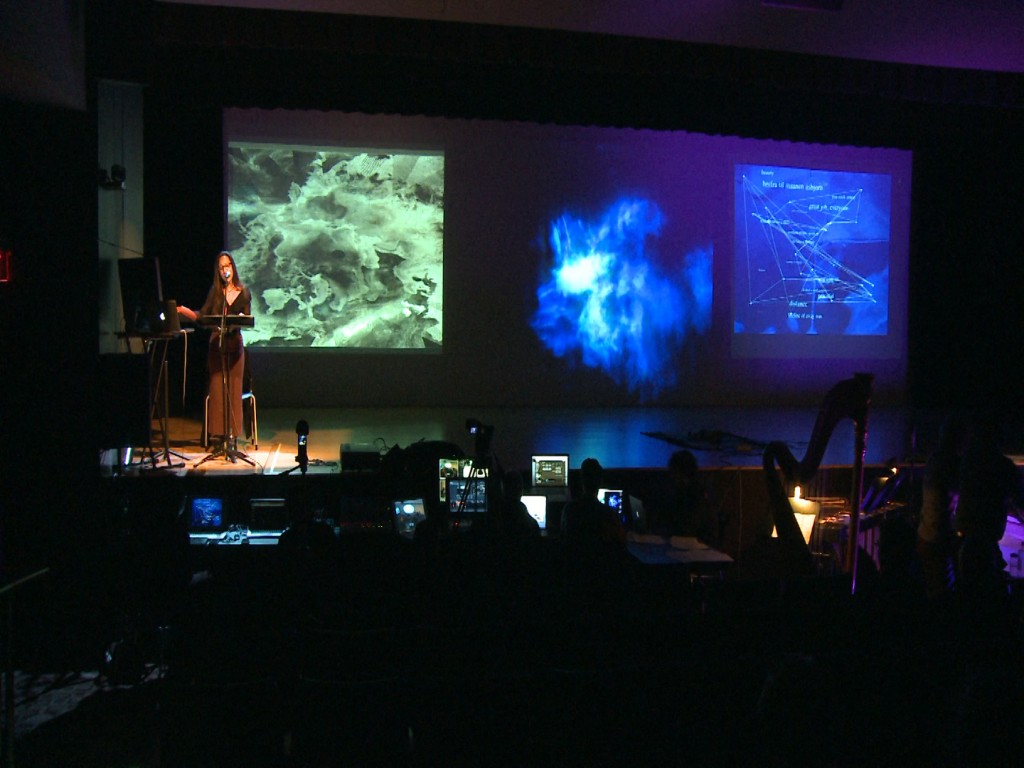
This week’s State of the Arts (SOTA) conference hosted by Arts Council England in Salford had, for the first time, two sessions on ‘Artists and our future environment’, with speakers James Marriott from PLATFORM; the writer Jay GriffithsMojisola Adebayo, writer, performer, director; and Andy Field, co-director of Forest Fringe.

All of SOTA’s sessions - on the creative economy, changing society, imagination, fundraising - touch on environmental themes. But these two drew out specific questions of the relations between artists and environments, of the material effects of artistic practices on the Earth, and of the importance of artistic expression of environmental themes.

This interest by SOTA in the environment comes about, in part, from talks between ACE London and arts organisations with an environmental focus in the London region – organisations who had lost their Regularly Funded Organisation status, and questioned ACE’s policies on the environment and climate.

James Marriott's session, transcribed on the PLATFORM blog, sets out how this collaboration between disparate organisations has worked, and how substantial shifts in ACE's environmental directions are taking shape.
more ...

Thursday, 16 February 2012

Island at the National Theatre

Abandoned whaling settlement at Pauline Cove, Herschel Island
Kellie Gutman reports:

A new play for children ages 8 and up runs at the Cottesloe Theatre 15-25 February.  Island, by award-winning author Nicky Singer (Feather Boy), has been commissioned by the National Theatre's Learning programme.  The play is set on the remote Arctic island of Herschel.

[It] raises questions about the effects of climate change on the island.  the play centres on a London schoolboy, Cameron, forced to spend his school holiday without computer, phone or Facebook with his scientist mother on the remote Herschel Island, where he encounters an indigenous girl whose stories open up this different world.

Along with the performances and workshops for family audiences at the Cottesloe Theatre, Island will tour to primary schools in London throughout the spring term.  


more ...

New on our news page

In London, the Royal Court Theatre is looking for 100 word plays, on any subject, to be posted everywhere throughout the building, on the walls, in the lifts, under drinks, on the tickets.

And the Tricycle Theatre is going nuclear with two plays about the atomic bomb. At ZSL London Zoo, ants perform in a robotic ballet. Across the country, Fevered Sleep is touring 'The Forest'.

In Newcastle and Gateshead, the AV Festival will move as slowly as possible through March, with walks, exhibitions, symposia, film and music on themes of time and duration.

The Sustainable Earth section at Fringe Arts Bath, and ‘The Home and The World’ event at Dartington are calling for projects and proposals.

The Centre for Contemporary Art and the Natural World is auctioning works on ‘My Favourite Tree’.  

The Eden Project hosts a day of psychological and artistic investigation into the ‘Nature Crisis’.

David Rothenberg launches his new book Survival of the Beautiful. Art, Science and Evolution. 
more ...

Tuesday, 7 February 2012

Plunge by Michael Pinsky

Michael Pinsky's Plunge, on three monuments in London
In a collaboration among LIFT, Artsadmin.and IMAGINE 2020, artist Michael Pinsky was commissioned to create a new work of public art in central London.  Today the project is launched and will remain on view through 4 March. Blue circles of LED lights have been placed on the Seven Dials Sundial Pillar, the Duke of York Column, and the Paternoster Square Column indicating the height of the sea level one thousand years from now, if climate change continues unchecked.

Though thousands of people pass these monuments every day, Pinsky's art allows people to see them in a new (blue) light.

Together, the Plunge monuments create an arc across central London, following the line of a future Thames that has swallowed much of the capital in its wake.

Plunge on Twitter
Plunge on Facebook
Plunge website
more ...

Friday, 27 January 2012

First daffodil in Low Wood


Wallace Heim writes:

Today, the first daffodil is blossoming here in Low Wood, Cumbria (latitude: 54 degrees North). There are two kinds of daffodil here, the garden cultivars and the small wild ones that fill the woods. This one, a cultivar protected by an old apple tree, will be in full, open blossom in a day or two, unless the forecasts are correct and the nights are cold and the snow is heavy.

The wild ones usually blossom earlier than the cultivars, but their leaves are only breaching the soil. Last year, the wild ones blossomed on 18 March. This one today is 7 weeks earlier that that.


more ...

Friday, 20 January 2012

Michael Pinsky LIFT unveiling 7 February


To celebrate thirty years of groundbreaking international theatre across London, LIFT  partnered with Arts Admin., as part of the IMAGINE 2020 network, to commission a new piece of public art work in central London.  Michael Pinsky, a renowned British artist, who has created artworks in public spaces and galleries across Europe, won the commission.  His work will respond to the issue of climate change.  This secret project will be launched 7 February 2012.  Stay tuned for more details.
more ...

Monday, 9 January 2012

Following spring's advance


For several years we have been following the advance of spring on the East Coast of the United States by participating in the Paideia School's science project.  Our editor, Kellie Gutman, writes:

The letter arrived on January 7th, the address printed in a 9 or 10 year-old's hand, with an accompanying postcard carrying this message:

I saw the first blooming daffodil on:__________, 2012
Kellie and Richard Gutman
West Roxbury, MA

The fourth and fifth grade classes track the speed of spring by documenting daffodil sightings along U. S. Route 1, from Florida to Maine.  It will be interesting to see how quickly spring arrives this year.  Here in Boston we have  had only one snowstorm, and that one freakishly early before Halloween.  Last year the school's letter arrived on a day that Boston got 8 inches of snow; this year it was a record 60 degrees fahrenheit.

In 2010, spring advanced at the speed of 1 mile an hour; in 2011 it was clocked at 1.3 miles an hour.

While waiting for the first bloom, you might want to re-read our 'flowers on stage' postings, to get into the springtime mode.
more ...

Tuesday, 20 December 2011

New metaphors for sustainability: include the craft of great design


Following Solitaire Townsend's suggestions for metaphors - teen-aged sex, Shakespeare, and advice to the dude - Ed Gillespie, co-founder of Futerra, emailed us to add a crucial component to the art of sustainability. Ed writes: 

To add to Soli's suggestions I would include: craft.

Sustainability is really all about craft - artful, considered, creative solutions that work for people and planet.

Sustainability is also the crucial third component of great design, building on William Morris's 'fit for purpose' (functionality) and 'beautiful to look at' (aesthetics). I add to these 'sustainably produced, reusable, durable, recyclable'. Sustainability turns good design into truly great design.

photo above of William Morris
more ...

Thursday, 15 December 2011

New metaphors for sustainability: teenaged sex, Tatiana's 'Weather Speech' and advice to the dude


Bill & Ted's Excellent Adventure.  Photo: Copyright 1989 Metro-Goldwyn-Mayer Studios Inc.


Solitaire Townsend, co-founder and director of Futerra, the sustainability communications agency, draws on sex, Shakespeare and the party spirit for three new metaphors for sustainability.

I’ve heard hundreds of definitions and metaphors for sustainability. For a decade my company Futerra has been communicating this precious, complicated, simple idea in communities, through brands and across continents. So I’ve picked three favourite metaphors which sandwich the sublime between two moments of the ridiculous.

The first is courtesy of my co-founder at Futerra the guru, professional comic and activist Ed Gillespie. This one comes with humour warning...

“Sustainability is like teenage sex. Everybody says they are doing it, but very few actually are. And those which are doing it – are doing it wrong.”

Ed loves opening conference speeches with that one.

The second isn’t really a metaphor but rather a poetic description of climate change. It’s the famous ‘Weather Speech’ by Titania from Shakespeare’s A Midsummer Night’s Dream (Act 2, Scene1):

The winds, piping to us in vain,
As in revenge, have suck'd up from the sea
Contagious fogs; which falling in the land
Have every pelting river made so proud
That they have overborne their continents:
The ox hath therefore stretch'd his yoke in vain,
The ploughman lost his sweat, and the green corn
Hath rotted ere his youth attain'd a beard;
The fold stands empty in the drowned field,
And crows are fatted with the murrion flock;
The nine men's morris is fill'd up with mud,
And the quaint mazes in the wanton green
For lack of tread are undistinguishable:
The human mortals want their winter cheer;
No night is now with hymn or carol blest:
Therefore the moon, the governess of floods,
Pale in her anger, washes all the air,
That rheumatic diseases do abound:
And thorough this distemperature we see
The seasons alter: hoary-headed frosts
Far in the fresh lap of the crimson rose,
And on old Hiems' thin and icy crown
An odorous chaplet of sweet summer buds
Is, as in mockery, set: the spring, the summer,
The childing autumn, angry winter, change
Their wonted liveries, and the mazed world,
By their increase, now knows not which is which:
And this same progeny of evils comes
From our debate, from our dissension;
We are their parents and original.

That in the 1590’s Shakespeare wrote the most chilling description of climatic upheaval inspired Ed and I to shoot a short film of the speech. Called ‘The Season’s Alter’,  it stars a young Keira Knightly.

The final example is my most often used. When asked to define or explain sustainable development I don’t call upon the great Bard, but rather upon Bill S. Preston, Esquire and Ted Theodore Logan:

“Be excellent to each other, and party on dudes.”


more ...

Thursday, 8 December 2011

New metaphors for sustainability: the Spanish Dehesa


Our series on new metaphors for sustainability continues with Alison Turnbull's 'Spanish Dehesa', a sylvopastoral system that marries production and nature conservation.  Alison was born in Bogotà, lives in London and exhibits her artwork there.  

I first saw the Spanish dehesa on a trip to Extremadura some twenty years ago. We drove for over fifty miles without passing another car and the temperature soared to 53º C. It was difficult to believe we were in Western Europe and not in the plains of the American west or crossing an African savannah.  I’ve been back every year since, walking and experiencing this unique eco-system in all kinds of weather, under all sorts of light.

Rather like the evocative Spanish term duende, used in the performing arts to mean ‘soul’ or ‘spirit’, dehesa is a difficult word to translate. Meadow, wooded pastureland and grazing operation, it is a sylvo-pastoral system that covers 20,000 square kilometres, mostly in southwest Spain but also stretching into Portugal and Morocco. It is one of the oldest created landscapes in Europe – a cultural landscape if you like - just how ancient no one quite knows, but certainly several centuries, and it remains an outstanding example of intelligent husbandry.  It is beneficial to the needs of human beings but also hospitable to a whole variety of other creatures, including many rare butterflies.

The grassed zones in between the oak trees are famously home to acorn-fed Iberian pigs that produce the most wonderful ham in the world. Honey, cheese, cork and charcoal are all products of the dehesa. It is an area of exceptional bio-diversity - for instance it is the wintering ground for most of Europe’s population of Grus grus, the common crane.

The dehesa is special in that it is an area where maximum exploitation sits side by side with maximum conservation. It’s man-made and it’s right here in Europe.


more ...

Monday, 5 December 2011

New metaphors for sustainability: a stranger's compass


Our co-editor Wallace Heim continues our series of new metaphors for sustainability with a guidance system that changes hands. 


Walking an unfamiliar Cumbrian fell with a compass, often without a map, links me to the land in a special way. The invisible, magnetic north that spins into place on the device is often perplexing and counter-intuitive. However reassuring it is to know there are vast forces of geology beyond any I can see, forces that co-ordinate my safe passage, I still have to negotiate the land right in front of me: that granite face, that swamped mire, that fast river. There is no picture in which to find myself, only wit, the land and the pull of a distant polar force.

A few times, I've come across a dropped compass. There's a moment when clearing the mud from its face when I wonder whether it was left behind because it was broken, or not believed. Is the north that was found in a stranger's hand the same as in mine?

I don't think sustainability can be likened directly to a compass, as if there was a pole of certainty to it. There are orientations that guide, but they fluctuate with a landscape that is continually shifting. The incremental decisions made in response to immediate conditions themselves change the situation, alter what is possible to do. I see sustainability as a response to change, one that keeps alive the capacity to respond to further change. What kind of compass would show this light-footed improvisation that makes sure those in the future can navigate their own way?

Walking with a stranger's compass comes closer as a metaphor. The compass is given, handed over, and it connects me to those I will never know, while helping me cross the land that I am in. The instruction is not reliable; maybe not safe. Or maybe it is, and the coordinates are sharper than on my own compass, signalling a clearer route. Is it pulling me in a direction I couldn't have imagined? This uncertain magnetism invigorates the walk. One day, I'll leave my compass behind. 
more ...

Thursday, 1 December 2011

New metaphors for sustainability: the surprises

Wallace Heim writes:

When we’ve asked people to think of a metaphor, we tried to present the idea of ‘sustainability’ in neither a positive nor a negative light, but to leave it as open as possible for people to interpret it in their own way. Even for the DVD, we filmed the four people without knowing ahead of time what their metaphors would be. We didn’t want to promote any one idea of sustainability.

It’s been surprising how positive the metaphors have been, even from those people for whom sustainability is not a strong idea, or from those who acknowledge its ambiguities.

It's also been surprising to see how people have found something, maybe not the grand conceptual metaphor, but something in their lives that relates to their view of sustainability. This is as important as the encapsulating metaphor, like the 'iron curtain' or the 'glass ceiling'. The metaphors have not been about a concept imposed from the outside, but about a relation between the idea and something from one's life that makes sense.

We'll be presenting more metaphors in the next two weeks. 
more ...

Monday, 28 November 2011

New on our news page

In Nottingham, there's a three-day celebration of the apple.

In Edinburgh, David Abram, author of The Spell of the Sensuous, and Being Animal: An Earthy Cosmology,  gives a public talk.

In London, Arcola's Green Sundays return with a focus on recycling and upcycling.

In the bookshops, David Rothenberg's Survival of the Beautiful investigates why nature is beautiful and how it has influenced science, Brendon Larson explores how metaphors entangle scientific facts with social values and Mojisola Adebayo's Plays One includes 'Moj of the Antarctic: An African Odyssey'.

There's a new funding stream for public art by Creative Scotland, and a call for runners to participate in NVA's Speed of Light at the Edinburgh Festival.

On the international scene, Conversation between Trees  uses sensors and mobile phones in the forest canopies in Brazil and the UK to communicate the light and colour of the trees and the changing climate around them.

Closer to home, Culture and Climate Change: Recordings is available as an online pdf and publication.
more ...

Thursday, 17 November 2011

New metaphors for sustainability: the Fetch (of a wavelength; to collect)


Our series of new metaphors for sustainability continues with Annie Cattrell's two meanings for 'Fetch'. A visual artist, born in Glasgow, living and working in London, Annie is a tutor at the Royal College of Art and a senior research fellow in Fine Art at DeMontfort University. She was on the 2011 Cape Farewell Scottish Islands Expedition.

I was first introduced to the oceanographic term the ‘Fetch’ while visiting I.C.I.T (International Centre for Island Technology) on Orkney during a residency I undertook hosted by the Pier Arts Centre in Stromness during 2010.

The Fetch (length) of a wave can be incredibly long. For example, it could stretch from the east coast of the United States, where it might originate, and travel uninterrupted by land mass across the Atlantic Ocean, arriving on the shores of the west coast of Scotland, in particular the Orkneys, where it would then be forced to break against the coastline.

The simple equation relating to this phenomena is that the length of a wave determines the power and energy of it.

As a consequence scientists and technologists based in Orkney are trying to harness the waves to create renewable energies for the future.

The uninterrupted ‘Fetch’ length of a wave seems like a strong natural metaphor for cause and effect. The behaviour of oceans, seas and weather generally would appear to override any political or territorial boundaries and constraints, reminding us of the larger rhythms of earth systems that can so easily be damaged and altered by different types of human made pollutants.

'Fetch' can also mean to go and collect and is to some extent predictive and about a future intention. Collecting and harnessing ideas and ways of living more sustainably would seem to be navigating in the right direction!

If not now, when?, Primo Levi
more ...

Monday, 14 November 2011

New metaphors for sustainability: the soil in my family's garden in Yorkshire


David Harradine is an artist working across performance, installation, publication and film, and is Artistic Director of Fevered Sleep. His metaphor for sustainability conveys his love for the transformations of soil.

We don’t even know what to call it, whether it’s soil or earth or dirt. 'Earthy' seems nourishing, homely, but we generally don’t like things that are dirty or soiled. Dirty implies sex, which is getting to the heart of the matter: productiveness, creation, fecundity.

I keep an allotment in Hackney, inner London. For seven years I’ve been digging kitchen waste into the ground, applying horse shit gathered on Leyton Marsh, and bagging up leaves from the London Plane trees by the children’s playground, waiting for them to break down into humus (brown nectar, nourishment, life). This soil, heavy London clay, grey brown, full of pebbles: this is sustainability. It’s what sustains me.

Everything I know about gardening – a knowledge that resides in my fingernails, the callouses on my palms, the ache in the small of my back, the blunt edge of my spade, and the dirty Tupperware box in which I keep my seeds – I learned in a garden in Yorkshire when I was a child. My grandfather was a market gardener. We grew gladioli, tomatoes, chrysanthemums, dahlia, potatoes and the spring onions for the market in Leeds. I remember one afternoon, my fingers stinking of tomato plants, when I asked him if one day the garden would be mine. I could not imagine how the life could continue without it. The very idea of family took root in that garden, with our hands and spades in that dark, scented, sensual soil; knowledge sown like seeds from generation to generation.

Soil: mineral structure fleshed out with the detritus of life and death. Wondrous recycler. Transformer of things into other things. As a child, it was unfathomable and miraculous to see the yellow-white flower of a double-headed chrysanthemum be created from heavy black soil.

Working my allotment in Hackney, I pull on the rake I brought from my grandfather’s garden. I have started to plan what I will do when my parents die, when that garden may no longer be ours. I think I will sack up some soil and bring it to London, because it carries time in it, and memory in it, and it carries my family in it, and I was grown in it. And I am sustained, here in the city, by the memory of the texture of it and the smell of it. And by the life, the life, the life that turns on an infinite cycle in the hidden dark depths of it.

photo: David's hands, his grandfather's rake, Hackney soil
more ...

Wednesday, 9 November 2011

New metaphors for sustainability: why we started

Wallace Heim writes:

We began thinking about metaphor and sustainability when we noticed that there weren't any strong or imaginative metaphors for the concept, or ones that we could easily use in conversation. Metaphors are pervasive in human thought and communication. 'Sustainability' stood out as an anomaly, a common concept with many definitions, but no metaphors.

So in April, we asked four people to suggest a metaphor and we filmed their responses. We weren't looking for 'the' metaphor. We were experimenting to see whether it was possible to think metaphorically about sustainability, in all its promise, its limitations and paradoxes.

Since then, we've added 14 more metaphors, (18 if you count everyone in the Institute for the Art and Practice of Dissent at Home), and will add another 6 through November and December, here on Ashdenizen and collected on the Directory.

Too, we'll be posting comments on the project itself, which for some contributors was challenging; for others, playful; and for others, a delicate expression of meaning taken from their everyday life.
more ...

Thursday, 3 November 2011

New metaphors for sustainability: the yew tree


Our series of new metaphors for sustainability will continue through November. Today, Peter Harrison, writer, artist and co-founder of Propeller Arts Collective finds solace in the shade of the yew tree.

A simple definition of sustainability is the capacity to sustain. For me, this immediately poses a problem. I’m aware that everything comes to an end, nothing can go on forever. There’s something not quite real about the word, implying the possibility of being liberated from death. But also there are nurturing, practical, organic aspects to the word, implying maintenance and growth.

Trees are living processes. Yew trees live for centuries. Although it is difficult to accurately date yew trees, it is estimated that the Llangernyw Yew, in Conwy, Wales, is over four thousand years old. Yews are associated with immortality, renewal and transformation. Yews are living entities that sustain while the world around them changes. The yew in Conwy sheltered people from the early Bronze age. It is tempting to think that one of those people stood under the tree imagining life four thousand years in the future. As generations came and went, the tree continued. Yews represent the passage from life to death, and beyond, into the land of shadows.

The timeless quality of yew trees can also be personally experienced. Stepping into the low-hanging canopy of a yew, there is a marked change in temperature and volume. The air is cool and still. The world is quieter. A space under branches. Natural sanctuaries in which to reflect, to slow down and contemplate life beyond the moment.

This is an uncertain world. In past centuries, when death was a more present, daily occurrence than it is now, maybe yews gave people hope that the world will continue. Hope that although one day we will die, part of the world we knew and loved will sustain.

photo: the Llangernyw Yew, Conwy, Wales
more ...

Tuesday, 1 November 2011

New metaphors for sustainability: song


Sue Palmer, an artist making live and digital work with people and place, and author of inquiline, a blog on botany and art, suggests song as a metaphor for sustainability.

the extraordinary song:
often straightforward, yet infinitely complex
the diversity (how many millions have been created)
the particularity (each one individual)
a structure enabling brilliant inventiveness
often a voice and an instrument
two kinds of sounds, working

my musician friend John talks about chords as metaphors
about how two ‘discordant’ tones are shifted
through the addition of a third note, bringing resolve

songs are free, and they can make someone a living
they help people make it through the day, and night
songs have changed peoples’ minds

a song can contain a lot of information, honed,
ideas packed in language,
rhythm, rhyme
there’s craft in it, and anyone can do it
there’s multiple ways to begin, and a sense when it’s complete

verse, chorus, verse, chorus, middle eight, chorus,
bridge
and key change, ‘ad lib to fade’
the pleasure of the repetition, letting the song free up, go

When I think of sustainability, I usually think of losing things, resources, capacity, and I find my materially-centred thought frustrating.

'If anything, I wanted to understand things and then be free of them. I needed to learn how to telescope things, ideas. Things were too big to see all at once, like all the books in the library - everything laying around on all the tables. You might be able to put it all into one paragraph or into one verse of a song if you could get it right', Bob Dylan, Chronicles, Volume One, 2004.

photo: by Orelie Grimaldi of John Cartwright playing C#m7
more ...

Friday, 28 October 2011

Margaret Atwood is with the bears

Margaret Atwood and Helen Simpson discuss I'm With The Bears, a new collection of short stories about climate change, with Mariella Frostrup on BBC Radio 4's Open Book.

Helen Simpson says one problem of writing about climate change is the moralizing:

"That's about as popular as telling someone they need to lose weight. It's the nagging and being preached at element that is very hard to avoid around this subject”. more ...

Thursday, 20 October 2011

New metaphors for sustainability: 'A matter of time'


Nick Robins’ metaphor suggests a profound shift in our perceptions of time. Nick works in the policy, operational and financial dimensions of corporate accountability and sustainability. He is author of The Corporation that Changed the World: How the East India Company Shaped the Modern Multinational (2006) and in 2011 was rated as the leading analyst for climate change research in the ThomsonExtel survey.

In the end, sustainability is all about the allocation of the scarcest resource: time. How much time do we devote to what in the present, and how do we balance the imperatives of time past, time present and time future?

The task, then, is to defeat the ravages of geological time and transfer those things of value from one civilisation to the next, particularly now that we have passed during our lifetimes from the Holocene to the Anthropocene.

Nearly all of what we consider to be valuable in human society occupies a tiny fraction of our existence as a species (some 2 million years).

For me, Homer's Iliad is the archetype of human value across time. As the poet Christopher Logue discusses in the introduction to his recent interpretation, War Music, the Iliad is already a work that has survived the collapse of a number of civilisations through luck, persistence and care. But will it survive ours?

The Iliad was written perhaps in the 8th century BCE, some 2,800 years ago. For me, sustainability means enabling those in the future to have an equivalent chance to benefit from this fundamental text, constructing an arc into the future 2,800 years long. This means that my time horizon is (or should be) 4811 AD, far further out that the 2050 timelines of the climate negotiations or the 'seventh generation' thinking of the counter-culture.

The consequences of this shift in perspective are profound: we need to conceive sustainability as beyond culture and indeed language, as the transmission of value beyond time.

All the metaphors in our series so far are collected here.
more ...

Monday, 17 October 2011

New metaphors for sustainability: the Kelo


We resume our series finding new metaphors for sustainability with the Kelo suggested by artist and researcher Amanda Thomson

For a few years now I have been spending a lot of time in some of the remnant Caledonia pine forests of Scotland, learning about their ecology, and making an ongoing piece of work called Dead Amongst the Living, which is ostensibly about the dead trees of these woodlands. Scots pines can live to be up to 300 years old, and even after they die, can stand for years before falling. In the middle of these woods, they sometimes stand pale like spectres amongst the greens, reds and browns of the living forest, and sometimes on the hills and moorlands of the north an occasional single tree reminds us of forests now long gone or the tenaciousness it has often taken to have survived.  

There’s a Finnish word a ranger told me, Kelo, which describes a standing tree which has died, dried out in the wind and yet remains standing, often for decades, only quietly and imperceptibly decaying. Like the shells of old croft houses in the far north west and on the islands, such trees stand to remind us of a different past, and are testament to earlier times.

Dead wood supports a huge amount of biodiversity when still standing, and once they have fallen they continue to form a crucial part of the living ecosystems of a pinewood; indeed, it is said they support more species when dead than they do when alive. These dead trees contain microhabitats for species which are not found elsewhere but which are vital to the ongoing health of the forest. They are havens for invertebrates, hold rare mosses, provide nutrients for lichens, fungi and liverworts. At each stage of their decay, they give something back to their surroundings and support different species at different stages of decomposition. When standing, they provide viewpoints for raptors and their holes and cavities provide nest sites for a range of woodland birds, including crested tits. Their rot holes are used by the larvae of rare hoverflies, green shield-moss grows on old stumps and capercaillie use the upturned root plates of the fallen for cover and for dust baths. Eventually, over a period of years, and by being broken down in a variety of ways, all of the nutrients which have been stored in the tree will make their way back in to the earth and replenish it.

For me, these dead trees contain an essential reminder about how in both physical and in psychic terms, things that seem no longer with us, things that might appear to be useless and redundant, and things that becomes invisible can continue to influence, support and nourish the present, and the living, in ways that we might not yet know, but will perhaps, in time, come to realise.
more ...

Tuesday, 11 October 2011

New fables for the woods

Why does the ash tree have black buds? Why does the yew tree live so long? Why does the chestnut tree have white candles? In a series of new fables about woods, 19 writers started with a question of this sort and found their way to an answer by writing a short story.

The collection, Why Willows Weep is published by the Woodland Trust. According to the editors, some fables are like fairy tales, others like Greek myths, and some are completely off-the-wall.

The writers are William Fiennes, James Robertson, Richard Mabey, Tracy Chevalier (who edits the collection), Susan Elderkin, Rachel Billington, Blake Morrison, Maria McCann, Terence Blacker, Joanne Harris, Philippa Gregory, Catherine O'Flynn, Tahmima Anam, Maggie O'Farrell, Amanda Craig, Ali Smith, Philip Hensher, Salley Vickers and Kate Mosse.
more ...

Thursday, 6 October 2011

My Last Car - final showings


My Last Car, commissioned by Tipping Point, I Move, and the Warwick Arts Centre, has its final performances today through Saturday at the Warwick Arts Centre.  Everyone remembers their first car; what if their present car were their last car?  The show looks at the influences the motor car has had on people's lives, and issues of sustainability.

The star is a soft-top Rover 216 broken down to its component parts.  My Last Car is both a gallery installation and a performance.  Information and tickets here.


My Last Car - Alan Dix, the man behind the wheel from imove on Vimeo.


more ...

Friday, 30 September 2011

Ecocide's day in court


Wallace Heim writes:

Today, the theatre of a mock trial plays out in the UK Supreme Court, live online (download the software at the top left of the panel).

The Ecocide Trial has Michael Mansfield QC as prosecuting barrister and Nigel Lickley QC as defence barrister leading a case for and against two fictional CEO’s, and is complete with expert witnesses, jury and judge.

The crimes chosen by the court this morning are the extraction of oil from Canada’s Tar Sands and the Deepwater disaster in the Gulf of Mexico.

There is no script. It is up to a jury to decide whether the case for Ecocide crime is made.

Follow the case on twitter and on Sky News/home/supreme-court.


more ...

Wednesday, 28 September 2011

Culture and Climate Change: Recordings


A pdf of Culture and Climate Change: Recordings is now available.

See four podcasts on culture and climate change
Download the podcasts
more ...

Monday, 5 September 2011

A final posting from Cape Farewell expedition

Shiants - watercolor by John Cumming
Kellie Gutman writes:

The artist, sculptor and writer John Cumming took part in the fourth and final week of Cape Farewell's expedition to the Shetland Islands this summer.  John was born and raised in Burra Isle, Shetland. He writes:

What draws me to these places is hard to define.  The journey is part of the magic.  The sea is endlessly, and wonderfully alive; unlike concrete, unlike tarmacadam.  No two sea journeys are ever the same.  On the trip to North Rona, we met families of dolphin, Risso’s, basking sharks and minke whales.  The sea was calm, the swell long and leaden.  The night-time journey back was before a north-easterly gale, sailing only on the jib.   Driving southwards at eight to ten knots, we listened to the clicking of a school of pilot whales some three miles away.

Next day the sheer sculptural magnificence of the Shiants was a revelation.  I have a personal lexicography of island profiles; the Kame of Hoy; the Kame of Foula; the Drongs of Eshaness; each place uniquely powerful and awe inspiring, yet even now, weeks later the basalt columns and screes of the shiants are etched on the back of my eyelids.

For his complete posting, including additional sketches, as well as postings of others on the expedition, see the Cape Farewell blog here.
more ...

Thursday, 1 September 2011

Sustainable production award: Allotment

Kellie Gutman writes:

The Center for Sustainable Practice in the Arts has awarded their 2011 Sustainable Production Award at the Edinburgh Fringe Festival.  The prize goes to Allotment, by Jules Horne and directed by Kate Nelson.  The show is set in an actual allotment and follows two sisters, Dora and Maddy, who work out their rivalries among the plants.  The show was chosen for successfully integrating its location into the drama.  See here for the full story.
more ...

Saturday, 20 August 2011

New version of 3rd Ring Out opens in Edinburgh


One of the winners of the 2010 Tipping Point commissions, 3rd Ring Out (which we blogged here and here) has now opened at the Grassmarket in Edinburgh. Its director Zoë Svendsen says:

We've now got a 'strategy' cell as well as a 'simulation' cell - we've split the use of the two containers into (1) short term crisis in a climate-changed future, under a business -as-usual scenario (which is the same format as last year but now about the Suffolk coastline); and (2) long term alternative futures about the city we are in, generated by ideas gathered from the public and others.


18-28 August, Edinburgh Fringe Festival
In the bright orange shipping containers. Grassmarket
Pleasance Courtyard
60 Pleasance
Phone 0131 556 6560

Other shows of interest at the Edinburgh Fringe blogged here
Zoë Svendsen's metaphor for sustainability on this blog and the Ashden DIrectory
more ...

Friday, 5 August 2011

Cape Farewell expedition reaches half-way point

Sheep pens, St. Kilda.  Photo: Ruth Little
Kellie Gutman writes: Cape Farewell's journey to the Outer Hebrides has reached its half-way point. The crews have changed each week, but the Associate Director, Ruth Little is onboard for the duration.  Her latest post, filled with wonderful pictures and observations can be seen here.

For all of the expedition posts go here or follow it on our blogroll. 
more ...

Thursday, 4 August 2011

New metaphors for sustainability: coral reef


Caspar Henderson, writer and journalist, suggests coral reef, its efficiency, vulnerability and beauty, as a metaphor for sustainability. Caspar's Book of Barely Imagined Beings: A Bestiary for the Anthropocene will be published by Granta in 2012.

As many people know, healthy tropical coral reef are among the the richest, most diverse and productive ecosystems on the planet, rivaled perhaps only by rainforests. It’s less widely appreciated, however, that this astonishing exuberance thrives in water that is very low in nutrients. The secret of the reef is that nutrients and materials are reused and recycled with great efficiency and rapidity in an almost closed loop.

Driving the cycle is sunlight, which is of course abundant in the tropics. Corals polyps, which are tiny animals, are able to build their layering and branching and skeletons (and thus over time the entire reef on which so much else depends) thanks to a partnership with photosynthetic algae called zooxanthellae, which harness energy from the sun and ‘feed’ their coral hosts in return for lodging.  Whether or not you believe in the claims made for next generation nuclear power (and, like Amory Lovins and others, I have doubts), an economy that is able to run on energy directly harvested from the sun, store it where necessary and turn almost 100% of its wastes into assets looks like a good way to go.

Another familiar fact about coral reefs is that they are among the ecosystems in the world most vulnerable to human meddling. Our assaults come in various forms including direct ones such as destructive fishing practices and nutrient overload from sewage and agricultural runoff, and indirect ones such as rising global temperatures and ocean acidification caused by a rate of change in greenhouse gas concentrations not seen in millions of years. 

Coral reefs can, we now know, thrive within certain boundaries, and be remarkably resilient to some shocks so long as the boundaries are not crossed. Once they are, however, the whole system can very quickly tip over into a degraded state. The reef becomes choked with slime and the food web disintegrates into a rotting boneyard that supports a dwindling band of scavengers. Previous perturbations to the Earth system comparable to current human activity have resulted in mass extinction events from which it has taken reefs millions of years to recover. We’re not talking about a metaphor here so much as a 400lb gorilla already standing on our toes.

The good news, in a far as there is any, is that we have a pretty good feel for what must be done if the threats to reefs are to be sharply reduced. Some of the most important measures such as stabilization and then reduction in atmospheric greenhouse gas concentrations may look unachievable in the near term, but while we continue to struggle with those there are many other things that will also be necessary and on which progress can (and is) being made now. One such is the creation, with local community involvement, of networks of Marine Protected Areas.

A final, and for me the most important point about coral reefs is that they are places of stupendous beauty and wonder. Chances are these are not qualities that spring to mind when you think of sustainability. A more likely association might be something like ‘sensible shoes.‘

But sustainability does not have to be boring. It can and must be highly dynamic, just as a coral reef is: an arena for competition and struggle, yes, but an arena with  limits and where new kinds of flourishing and cooperation are forever unfolding. Cruelty, suffering and death are not eliminated, but the scope for doing your own thing or doing something new - whether it be to bake cakes with five year olds, develop greener energy technology, or dance flamenco while dressed as a flamboyant cuttlefish - is greatly increased.

photo:  Gray Hardel/Corbis
more ...