Showing posts with label playwrights. Show all posts

Wednesday, 6 April 2011

what happens when you turn on a light switch?

A 2009 Tipping Point winner, The Light Switch Project, will be broadcast on Tuesday, 19 April, on BBC Radio 4, at 11 am.  The story follows the actor Toby Jones as he tries to figure out what happens when you flick that switch.

See also: what you are doing when you flick that switch
assessment of latest tipping point commissions
Tipping Point winners announced tonight
more ...

Saturday, 26 February 2011

why human rights activists are not like climate scientists

In the last blog, would a play about climate scientists be the best way to write about climate science?, the point was made that a play about human rights didn't have to feature a human rights activist.

The analogy between human rights activists and climate scientists has prompted a couple of emails.

One email pointed to the difference in the way the professional and emotional lives interacted:

I think climate scientists and human rights activists are completely different in terms of the potential tension between their emotional and professional lives, the material they are working with and how they are viewed publicly.

The other suggested that the kinds of knowledge that each work with and represent are fundamentally different.

Science is so embedded in knowledge about climate change, that it is a different kind of thing to human rights. So I'm not sure the comparison really holds up. Does this matter? Maybe not in a general kind of way - if what this means is that the 'specialist' or 'expert' is not the only person who can speak. But it does matter in a more specific way - that in thinking about climate change on stage - it might be a relief to get rid of the scientists, but one may still have to come to grips with science - in much more complexity than just the 'facts' or 'predictions' or 'scepticism'. more ...

Friday, 25 February 2011

would a play about climate scientists be the best way to write about climate science?

In wanted: a portrait of the climate scientist as a real person, this blog argues that

the most interesting characters to put on stage right now are climate scientists ... simultaneously appalled and fascinated by what they are discovering.

The artist and theatre-maker Tim Nunn responds

My trouble is not wanting to use climate scientists at all. Is it the same as writing about human rights by portraying a human rights activist? (That isn't a rhetorical question by the way.) Your last paragraph makes it sound as if the climate scientists would do a pretty good [job] themselves if they were given the chance - why should we represent that on stage? (Again, not a rhetorical question.) I've been torn about this for ages and not finding a way through.

True, there's no reason why a play about climate science need feature any climate scientists. A good play is about more than its immediate subject matter. For instance, David Hare's The Permanent Way is about the privatisation of the railways. But its real theme is grief.

That said, there have been important plays that are fairly directly about scientists. In Science on Stage, Kirsten Shepherd-Barr lists "a wonderfully diverse" range of scientists who have (since Brecht's Galileo) peopled the stage.

Her list mentions Bohr, Heisenberg, Ernest Rutherford, Marie Curie, Lise Meitner, Ralph Alpher, Sigmund Freud, Carl Jung, Rosalind Franklin, Thomas Huxley, Tycho Brahe, Johann Kepler, Stephen Hawking and P.A.M. Dirac.

Yes, climate scientists can do a good job representing themselves. But playwrights can do a good job representing them too.

Interestingly, Science on Stage makes no mention of climate scientists. (It was published in 2006.) But it's evident that James Lovelock has been the inspiration behind characters in The Contingency Plan - Steve Waters talks about this here - and Earthquakes in London.

But Tim Nunn is quite right: a play about human rights does not have to feature a human rights activist. more ...

Thursday, 24 February 2011

wanted: a portrait of the climate scientist as a real person

In his preface to The Coast of Utopia, Tom Stoppard makes the point that writers can have real political influence. His example is Turgenev's Sportsman's Sketches, which Stoppard writes,

"were plausibly said to have done more than anything else to turn the 'Reforming Tsar' Alexander 11 towards abolishing serfdom."

But the writing has to be precise and observant. Earlier in the preface, when discussing Alexander Herzen, Stoppard writes,

"What he detested above all was the conceit that theoretical future bliss justified actual present sacrifice."

Twentieth-century history was on Herzen's side. It's easy to imagine, today, that many playwrights' resistance to climate change as a political subject comes from this idea that it deals with a "theoretical future" and that it is being used to justify "actual present sacrifice". Playwrights like to write about real situations, flesh and blood characters, the here and now. And they like jokes.

In some ways, then, the most interesting characters to put on stage right now are climate scientists: not a climate sceptic disguised as a climate scientist (as happens in The Heretic), but the climate scientists who are simultaneously appalled and fascinated by what they are discovering.

At last year's TippingPoint conference in Oxford, climate scientists spoke candidly and wittily about how their work had altered their lives and their world views. If caught accurately, that kind of portrait might have real political influence.
more ...

Friday, 11 February 2011

two very different plays about climate change share some things in common

"Climate change drama is the new growth industry", writes Michael Billington in today's Guardian. Well, about bloody time.

Greenland opened at the National on 1 February, and Richard Bean's The Heretic opened at the Royal Court last night. They couldn't be more different.

Greenland has four authors, multiple storylines and an anxious desire to reflect the range of positions people have taken on the subject. The Heretic is the work of one author, its science is about as plausible as its plot-line, but it's got some great characters and some very funny jokes.

If the two plays are similar at all, it's in what they don't achieve.

Neither play catches the intensity of feeling that surrounds these issues in the developing world. They are Eurocentric, when understanding how one half of the world impacts on the other is central to the subject.

Nor does either play give a genuine sense that the news contained within the IPCC reports changes our view of the world, and our place in it. The reports do this, and they do it as profoundly as Galileo stating that the earth revolves around the sun or Darwin stating that all species of life have a common ancestry.

These are ideas that can't be speedily researched by playwrights. They raise large philosophical and ethical questions. (The first report was published in 1990, so we've had 20 years to think about it.) But the ideas have to be lived with, experienced and internalised.

At the moment it feels as if playwrights are reacting to the journalistic noise around climate change. When the deeper ideas do emerge in plays, and these ideas inform the actions of the characters, the immediate subject of the play may not even be climate change.

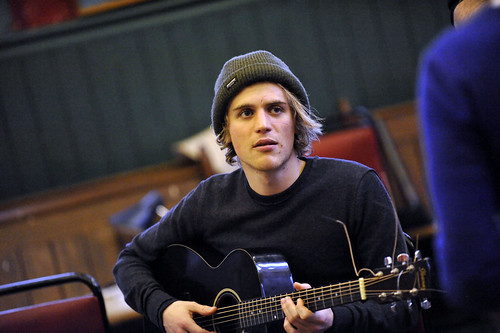
Pic: Johnny Flynn in rehearsals for The Heretic. more ...

Tuesday, 8 February 2011

david hare's documentary subjects

David Hare on writing documentary dramas.

“I am never comfortable until I can understand a way of it being more than the subject matter.”

"When I go to see a film like The Social Network, then I feel a kinship, I feel they are doing exactly what I am trying to do, which is to make a modern myth out of quasi documentary theatre. But in the theatre, I feel incredibly lonely.”
more ...

Wednesday, 2 February 2011

british playwrights have "blithely ignored" climate change

British theatre prides itself on being contemporary, up-to-date - in a word, hot. So it’s odd that, over the past decade, there have been so few plays about climate change. While everybody, and I mean everybody, has been talking about global warming, while climate-change deniers have been branded the new fascists, and while well-publicised protesters have tried to stop electricity stations from functioning, British playwrights have - with only a couple of exceptions - blithely ignored the subject.

From first paragraph of Aleks Sierz's review of Greenland for The Arts Desk

Why theatres don't touch climate change
From no plays about climate change to three in a month
Finally a good play about climate change more ...

Thursday, 13 January 2011

what scientists believe in

The short two-sentence quote that accompanies the publicity for Richard Bean's The Heretic at the Royal Court runs: “I’m a scientist. I don’t ‘believe’ in anything.”

I prefer the view of the female scientist in Kim Stanley Robinson's Forty Signs of Rain. When pressed about what she actually believes in, Anna replies the double blind study. more ...

Friday, 26 November 2010

leading climate blogger says it's time to modernise ibsen

In his Thanksgiving post, Joe Romm at ClimateProgress gives thanks for climate scientists.

They are like the hero of Henrik Ibsen’s classic 'An Enemy of the People' — which, come to think of it, someone should modernize into a climate science parable.

See also: Ibsen's Wild Duck first play to put a laboratory animal onstage. more ...

Thursday, 30 September 2010

type in water

Following yesterday's announcement that the topic for Blog Action Day on October 15 was 'water', here - as a starter - is the list of companies, plays and productions on our directory database that pops up when you type in 'water'. more ...

Wednesday, 22 September 2010

secret's out

Steve Waters, who wrote the first good play about climate change, has a new book out: The Secret Life of Plays. more ...

Friday, 3 September 2010

tackling the range

When Athol Fugard attacked younger playwrights for not taking enough interest in politics, he could make an impressive claim:

In South Africa we had to work in small venues, but our dissident writers made a major contribution to the fact that dialogue eventually replaced bombs and bullets.

It would be hard for younger playwrights to rival that kind of impact. But no interest in politics? In the comments that followed, DaveSplendour suggested - with all due respect to a very distinguished playwright - that maybe Fugard hadn't been keeping up with the work of younger playwrights:

this doesn't even hold water even if you do look at plays which are more straightforwardly political – DC Moore, Lucy Kirkwood, Mike Bartlett, James Graham, Bola Agbaje, Lucy Prebble, and Matt Charman are all tackling a range of subject matters in their work including climate change, British foreign policy in the Middle East, the complicity of NGOs in African war crimes, sex traffic, as well as British domestic policy and social cohesion. more ...

Thursday, 2 September 2010

be ironic, be non-committal

Playwright Emma Adams responds on the Guardian theatre blog to Athol Fugard's remarks on Monday that playwrights are avoiding the political and writing for attention spans of 10 minutes between adverts.

Emma Adams' new play Ugly is about climate change. Even admitting this, she writes, means she will be suspected of being "too intense, and not a good laugh".

I guess other writers may also sense the prevailing mood out there is: "Keep it light: if you must be informed, be ironic, and most importantly be non-committal about everything, other than the fact that paedophilia is evil." more ...

Wednesday, 1 September 2010

reader of history

Playwright Tony Kushner on Karl Marx

he was an absolutely astonishing reader of history, and of class. His analysis of capitalism is being proved in America every day. more ...

Wednesday, 25 August 2010

a topical theme for the new york state theater

Two years ago this blog listed six reasons why theatres won't touch climate change. The final reason was: "Many of the leading fossil fuel companies are prominent sponsors of the arts."Things have moved on since then. Most recently the National has staged a climate-change play.

But Jane Mayer's remarkable profile of the oil and gas billionaires, the Koch brothers (blogged below), reminds us how deeply and persistently the richest fund disinformation about climate change.

David H. Koch has also given $100 million to the New York State Theater (above).

The David H. Koch theater presents the work of the New York City Opera and the New York City Ballet, but it would be very cheering if the New York State Theater demonstrated its artistic independence and staged a piece that was as urgent, well-informed and witty as Steve Waters' climate-change play The Contingency Plan.

No serious theatre - whoever's name it carries - should fiddle while Rome burns. more ...

Thursday, 19 August 2010

bush playwrights go online

The Bush has a website Bushgreen (ht: Guardian's theatre blog) where you can submit plays and publish plays online.

It also has a bunch of interviews with Bush playwrights, including Steve Waters, who wrote the first good play about climate change. At the moment, he says, he's writing a screenplay of The Contingency Plan and a new play for the Donmar. (See our Steve Waters interview and googling waters.) more ...

Tuesday, 13 April 2010

excess and earthquakes

The National Theatre has just announced its summer programme, including a new play by Mike Barrett called Earthquakes in London.

The press release says the play's action is driven by 'an all-pervasive fear of the future and a guilty pleasure in the excesses of the present'. more ...

Monday, 12 April 2010

take it from chekhov, nature doesn't weep

In his article on the American novelist and short story writer John Cheever, Edmund White makes a number of illuminating references to Chekhov.

White decribes Chekhov as an ecologist avant la lettre (see our Chekhov as proto-environmentalist) and goes on to quote a letter Chekhov wrote to the young Maxim Gorky in which Chekhov takes issue with Gorky's descriptions of nature. Chekhov characterises Gorky's anthropomophic approach as:

The sea breathes, the sky looks on, the steppe basks in the sun, nature whispers, speaks, weeps, and so on.

Chekhov explains to the younger writer:

In descriptions of nature, vibrancy and expressivity are best produced by simple techniques, for example: using simple phrases such as 'the sun set', 'it got dark', 'it started to rain', and so on. more ...

Sunday, 21 March 2010

this isn't jazz

Sam Shepard tells an interviewer: 

We're not having a dialogue, this is question and answers. Dialogue is like jazz. Dialogue is creative. more ...

Monday, 15 February 2010

after wolves, mrs becks

Playwright Samantha Ellis, who wrote a journal for us on researching her play The Last Wolf In Scotland, has a new play opening tonight at the Birmingham Rep. Her new play, Cling To Me Like Ivy was inspired by :

a chance remark by Victoria Beckham in 2004 which sparked a crisis within the Orthodox Jewish community about the wigs worn by married women. more ...