Showing posts with label low impact. Show all posts

Monday, 16 May 2011

bottom gear

In a recent column Top Gear presenter Jeremy Clarkson appears to be envying the life of the forager.

"If you do lose your job and you end up living in a barn, with just a fire to keep you warm and nothing to eat but what you can find in a hedge, be happy. Because you'll be having a much better life than me." more ...

Sunday, 13 March 2011

economist wonders if hunter-gatherers got it right

Monik Gupta has translated posts from ashdenizen for Oeko Fakt. In this guest post, Monik links our blog about Heart of Darkness with research at the Max Planck Institute.

The recent post about Conrad's Heart of Darkness, and its central theme of consumption of resources in the world, resonates strongly in the German broadsheet Süddeutsche Zeitung.

Astrid Matthey, a scholar at the Max Planck Institute for Economics, questions the widely-held belief that increased wealth and prosperity is closely related to increased well-being, citing research which fails to show such a relationship both in industrial as well as currently developing countries.

"We can no longer afford to leave it to each individual whether to say 'no thanks' in a society focused on consumption; simply because saying 'no thanks' is so incredibly hard for the homo relativus as long as consumption is the measure of all things ... it doesn't allow for the degree to which our current lifestyle threatens the global provision of resources and world peace."

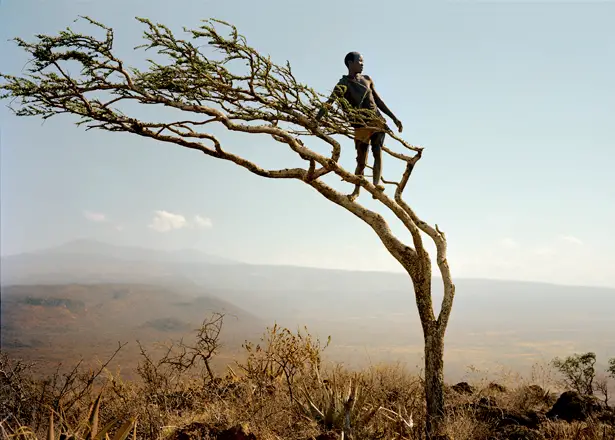
"National Geographic reports on a community of hunter-gatherers in Africa (pic), who happily spend a major part of the day with leisure time, instead of 'striving for more'. Concluding, the author asks: 'What do they know, which we have forgotten?'"

See German version of post about climate change jokes
The other post that's been translated into German is about two very different plays about climate change. There's no exact translation, Monik says, for the English expression "about bloody time", so he went for the politer Das wird aber auch langsam Zeit.
more ...

Monday, 26 July 2010

wheels of change

Andrew Gillingham writes:
The railways owned the 19th century; the 20th was the age of the car. But as Alberto Contador processes up the Champs-Elysees to win the Tour de France, and as London's mayor, Boris Johnson, unveils his massive cycle-hire scheme, could this be the century of the bike? 

more ...

Wednesday, 21 April 2010

his grass is greener

The American author Robert Wright (The Evolution of God) likes to see dandelions on his front lawn. He'd also rather not douse his grass with 'pre-emergent' herbicides.

But his neighbours think it'll affect property prices. more ...

Wednesday, 10 February 2010

lights out

A letter in the Daily Telegraph argues for more natural darkness:

Churches, empty car parks and gardens don’t need night lighting. more ...

Thursday, 21 January 2010

anything but simple

A higher percentage of people in Central and Eastern European countries grow their own vegetables than in Western European countries, and this applies to people living in the city as much as the countryside.

But this isn't merely a hangover from an agrarian culture or peasant traditions. Plenty of middle-class people in Prague (pic), for instance, grow their own food and one of the motives (interviews show) is that it can be a reaction to the neo-liberal values that swept the country since 1989. Acting sustainably, however, was not a priority.

This blog was attending an open space seminar on self-provisioning at The Open University yesterday where two lecturers, Dr Petr Jehlička and Dr Joe Smith, were sharing their recent work on informal food production.

One slide from a study by Alber and Kohler detailed the level of self-provisioning in each European country. The Western European country with the highest amount of grow-your-own stuff was Luxembourg.

In a discussion that followed about voluntary simplicity, one participant asked: "Why is it called voluntary simplicity. My partner grows his own vegetables, and it's anything but simple." more ...

Tuesday, 15 December 2009

low impact woman

Several lines from Irving Berlin's Annie Get Your Gun, currently playing at the Young Vic with Jane Horrocks (left), have a timely resonance.

For all her sharp-shooting, Annie Oakley emerges as a low impact woman: no diamonds, no pearls, no mansion, no yacht, no silver and no gold. Even wiser:

Got no checkbooks, got no banks,
Still, I'd like to express my thanks.
I've got the sun in the morning
And the moon at night
more ...

Thursday, 13 August 2009

from men in black to man in green

The L.A. Times reports:

In a classic Hollywood twist, No Impact Man, about a New York family struggling to live without refrigeration, electricity and even toilet paper, is being reworked as a possible drama for Will Smith. more ...

Monday, 6 July 2009

what the new narrative describes

The founder of the Eden Project, Tim Smit (left) elaborates on what he means by 'hippy shit'. He says he in no way meant:

'to decry the efforts of those who are encouraging the first steps in community action through various mediums such as growing your own and so on, merely that we have been here before many times and the danger of becoming over impressed with such steps is that it drowns out the scream from the future that a truly radical shift in philosophy and leadership is required - one that questions the fundamentals of the way we do business, measure growth and take on responsibilities as citizens as opposed to just being aware of our rights.'

The target is to cut our carbon footprint by 80%. To succeed in doing this:

'we need a new narrative, one that describes the sunny uplands our society is striving to reach and the reason why adopting a philosophy which sees us recognising our part in and responsibility to the natural world will see us working with the grain of nature and not against it.' more ...

Wednesday, 24 June 2009

what makes a difference

If you’re concerned about your personal finances, or energy security or climate change, and you want to cut down on your use of fossil fuels, Sustainable Energy—Without the Hot Air explains which actions make a significant difference and which make very little. more ...

Friday, 5 June 2009

lost in aviation

The anthropologist Grant McCracken sums up flying as an experience for business people:

'canceled flights, late arrives, missed connections, lost luggage, being forced to sit in a plane on the ground because the airline wants to protect its on-time departure rating. The list goes on. In the early days, air travel was something glamorous. Now it's more like a kidnapping by amateurs.'

So much easier, he says, to stay where you are:

'compare the investment you are obliged to make to get from your desk to the boardroom at the end of the hall to all the things you need to get from New York to and from Chicago.'

His solution for businesses? Live face-to-face communication over the network. What it needs is some very smart marketing to push adoption of the technology (that already exists) over the tipping point.

(Our new online DVD on 'theatre in a time of climate instability' is an effort towards non-flying transatlantic conversation.)

Pic: Heathrow more ...

Thursday, 9 April 2009

from debt to drought

The novelist Margaret Atwood was raised in Canadian woods - often without electricity - by 'two environmentally-aware biologists, back when that was a pretty moony thing to be.'

Her most recent book Payback is about debt. Her next book Year of the Flood, out this September, is about a catastrophic drought. more ...

Wednesday, 1 April 2009

scudding cloudcuckooland

Cloudcuckooland (pic) is a loose adaptation of Aristophanes' The Birds. It takes the idea that there are 27 times as many birds as there are humans, so if birds revolted against humans for trashing the planet, the birds might win. The secret weapon the birds employ, as they launch attacks on major cities across the world, is bird poo. (Tour dates here.)

Last week, Cloudcuckooland's producer Helen Eastman wrote a message on the internal email for SCUDD (Standing Conference of University Drama Departments) outlining the show's environmental credentials:

'We send the cast everywhere by train rather than driving them, and we offset all our flights. The show has a lot of props, so we have to be certain that they are all kind to the environment ... We've got a brilliant cast and crew, and we always get fantastic feedback from kids and their parents. I think that's why everyone's prepared to go the extra mile to practice what the show preaches.'

This led to a good exchange. Steve Bottoms, from Leeds University, took exception to this 'self-aggrandising publicity fluff', writing back:

'The fact is that theatre -- like very much else in our everyday experience of the world -- is an inherently carbon-emitting activity, and we need to face up to this rather than pretend that "the creation of a completely sustainable touring model" is this easily achievable.'

Helen Eastman replied, saying 'fair comment, but you have to start somewhere'. Eastman went on:

'When we took this show to Edinburgh last summer, we discovered that the festival (unlike most music festivals etc) had no environmental policy on its website, no attempt to get people (audiences or companies) to share transport to get there, no policy for recycling the millions of fliers handed out in the streets.'

Franc Chamberlain, from Cork University, joined the debate:

'There are people on this list [SCUDD] who've been engaged in environmental politics and trying to be environmentally aware for over thirty years. if you're serious about raising the awareness of some festival organisers, then band together with other interested companies to force change and simply don't go if the festival organisers aren't prepared to make changes. There are plenty of other festivals that are concerned about environmental issues.'

Gareth Somers, from Portsmouth University, took the challenge to another level. Leaving aside the specifics of Cloudcuckooland, he wrote to point out that many people on the SCUDD list:

'question the value (in ecological terms) of a humanist theatre that supports anthropocentric values. In this light sustainability might be viewed as green-washing - Is a theatre that exploits the "natural world" as metaphorical resource to discuss human centered issues, in itself an ecologically positive force - whether the production be sustainable or not?' more ...

Monday, 19 January 2009

give it up for (the other) michelle

At the start of No Impact Man's blog (which I first wrote about in summer 2007), there was a winning sense that Colin Beavan's guilty Liberal idealism was on a collision course with his wife Michelle's 'Prada-wearing, Four Seasons-loving' lifestyle.

In the early months of NIM, Beavan was foisting his eco-fundamentalism onto his Manhattan wife and their young child, and hastily blogging his anxieties about doing so on his solar-powered computer - before the light went.

Nowadays the NIM blog is more like a support network for well-intentioned green people. But it's encouraging to learn that the movie-of-the-blog (what a new genre that is) keeps those early competing voices in the foreground. The LA Times says the movie could have been preachy and self-righteous, but turns out to be funny and informative.

'In large part, that's thanks to Michelle, who becomes our voice in the production -- from her admitted addiction to everything from shopping to coffee (no beans are grown within the roughly 250 mile radius they set for any of the food products they bought), to her discomfort with the composting bin in the house, complete with earthworms and, in the summer, flies.' more ...

Monday, 24 November 2008

the return of thrift

Fay Weldon reviews India Knight's Thrift Book

A distaste for excess crept upon us unaware, pre-dating the credit crunch and the fear for jobs: one day, bottled water seemed normal; the next day not. One day, leaving the computer on all night seemed bold and trusting, a gesture of defiance; the next, it seemed a senseless waste.

If Fay Weldon had been following any of the low-impact blogs linked to on this blog, she might not have been caught unawares. more ...

Tuesday, 11 November 2008

cold toes and driving rain

A fortnight ago this blog mentioned Run for the hills, a blog by Simon Lee, who'd left his job as chief executive of Changeworks and moved to a small croft in the north of Scotland to reduce his carbon footprint.

Lee was flattered, but puzzled, to discover from his Google stats that he was getting visits from this blog and the Ashden Directory.

A blog about theatre and climate change is always going to want to highlight examples about low impact lives and voluntary simplicity, from Diogenes and Wittgenstein to No Impact Man and Crunchy Chicken. Lee's is the latest. Yesterday, he writes, 'the main thing I'm concentrating on is how cold my toes are and just how wild the driving rain sounds against the velux windows.'

See also: blogging the good life. more ...

Sunday, 9 November 2008

austere and monkish

The philosopher Ludwig Wittgenstein (left) would not have had to worry about his carbon footprint. His rooms in Cambridge were almost bare of furniture. He didn't mind what he ate (it's said) so long as it was always the same thing. He even became a gardener in an Austrian monastery and slept in a potting shed.

The monkish austerity of his prose style in Tractacus Logico-Philosophicus, writes Terry Eagleton, was (among other things) a reaction against a Viennese world of cream cakes and swollen bodies. more ...

Thursday, 23 October 2008

voting with his feet

For six years Simon Lee was chief executive for Changeworks. Now he's moved to a small croft in the north of Scotland to reduce his carbon footprint. In Run for the hills, he writes, 'If democracy can't defeat climate change I suspect climate change will defeat democracy anyway.' He posted that thought on No Impact Man's Open Discussion and was challenged to elaborate. more ...

Wednesday, 22 October 2008

365 days of trash

One man's attempt to throw nothing away for a year. more ...

Tuesday, 21 October 2008

where smart is heading

It's smart to use the things that are limitless and free. It's smart to think about where stuff comes from and ends up. It's even smarter to close the loop between the two. My piece for Intelligent Life about the low-carbon future. more ...