Sunday, 12 October 2008

into neutral

To understand modern politics in Europe, writes Tom Holland, you have to understand Europe's Christian past

Neutrality, in the dimension of culture and religion, can never itself be a neutral concept: it is too much the product of Christian presumptions and history ever to rank as that. more ...

slipping

In a 1,200-word statement about his priorities for government David Cameron failed to mention the words 'environment' or 'climate change'. more ...

Saturday, 11 October 2008

'theatre revels ...'

writes Guardian theatre blogger Andy Field,

'in the directness of its relationship with the real world. It is the perfect medium to begin playing with and making something wonderful out of our ever-more miserable weather.' more ...

out of the dark

When electrical problems at the Bush theatre took out the lighting, they scheduled a series of plays in natural light. more ...

Friday, 10 October 2008

170,000 sign

Petition asks ABC to reconsider its ban on too 'controversial' ad that promotes alternative energy. more ...

topical developments

Most Victorian scientists kept faith

'with at least one major inheritance from the Romantic period: the belief that science should be conducted in a language available to all intelligent citizens, and that the public should always be educated both in its deepest fundamentals and in its most topical developments.'
more ...

a tragedy of shakespearian proportions

Because McCain did it to himself. more ...

the next great global industry

Thomas Friedman's new book is as much about America, he tells Elizabeth Kolbert, as it is about the next big thing - energy technology

the whole purpose of my book is to redefine green. To redefine it as a geo-political, geo-strategic, geo-economic, patriotic. Green is the new red, white and blue.
more ...

david miliband's either/or

'So the choice is not between an economic growth lifestyle and climate change—I think it is high carbon lifestyle versus low carbon lifestyle.' more ...

Thursday, 9 October 2008

why he likes early cultures

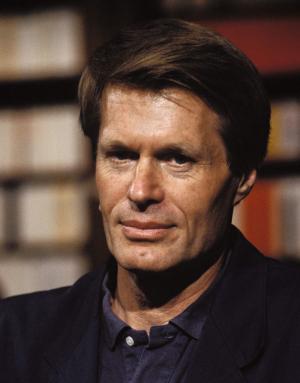
The 2008 Nobel prize-winner for Literature, Jean-Marie Gustave Le Clézio (left), says

The dawn of peoples is important because we seem now to be living in the dusk. You have the sense that we are getting near the end.

For those who haven't read Le Clézio, a French professor at Columbia University explains his appeal, 'There is a concern for civilizations, a concern for ecology.' more ...

disko days

We've been following Cape Farewell's Disko Bay trip here. They had a bigger boat, more people and better weather than last year. Our associate editor Kellie Gutman, who's been keeping up with the blogs, says:

the most prolific blogger is the comedian Marcus Brigstocke. But all of the crew is blogging, and they are often very long, thoughtful, introspective, descriptive blogs - which is quite a change from last year. We've just scratched the surface with our sampling. There are a lot more video clips as well, and the official photographer has snapped great photos. more ...

the romance of science

Jonathan Bate reviews Richard Holmes' new book The Age of Wonder

Building on a generation of revisionist scholarship that has been barely visible beyond the groves of academe, Holmes triumphantly shows that the Romantic age was one of symbiosis rather than opposition, in which scientists such as Sir Humphry Davy were also poets and poets such as Coleridge had a shaping influence on scientists - we discover indeed that it was Coleridge who was responsible for the early 19th-century invention of the term 'scientist' as an alternative to the older nomenclature 'natural philosopher'.

H-t: Bookslut more ...

doing even less

Nearly two in three opinion leaders (63%) think that sustainability is a low or non-priority for business - and close to half (47%) believe that businesses will do even less in the current economic climate. more ...

the ad ABC won't run

They'll take an ad from Chevron, but not this:

The solution to our climate crisis seems simple. Repower America with wind and solar. End our dependence on foreign oil. A stronger economy. So why are we still stuck with dirty and expensive energy? Because big oil spends hundreds of millions of dollars to block clean energy. Lobbyists, ads, even scandals. All to increase their profits, while America suffers. Breaking big oil's lock on our government ... Now that's change. We're the American people and we approve this message. more ...

verbage

So close to garbage, so far from language. more ...

the audition

He cynically picked a running mate with less care than theater directors give to picking a leading actor’s understudy. more ...

Wednesday, 8 October 2008

nuts and bolts

Australian theatre critic Alison Croggon quotes the Austrian novelist Robert Musil (left), who maintained that,

'if there was to be real social change of any kind, what was required more than anything else was not idealists nor intellectuals, but managers: those who knew the nuts and bolts of creating and maintaining organisations, and understood how to change organisational structures.'

H-t: Theatre Ideas. more ...

Tuesday, 7 October 2008

make-up

The U.S. has 5% of the world's population, says the Wall Street Journal, and burns 23% of the world's oil. But what's striking is the make-up of the carbon footprint.

'Industry -- including oil, steel, chemicals and cement -- produces 23% of U.S. greenhouse-gas emissions, according to the McKinsey study. But a handful of other emission sources more directly controlled by consumers far outweigh industry when those sources are pooled together ... Consumer behavior affects virtually all man-made greenhouse-gas emissions because consumers drive the economy.' more ...

Monday, 6 October 2008

revelation

The psychoanalyst Adam Phillips discusses Oedipus with Ralph Fiennes,

'The process of revelation in the play is as interesting as what is revealed. ' more ...

Friday, 3 October 2008

other people

Nick Elliot, ITV's head of drama (1995-2007), gives his advice to dramatists writing for mainstream ITV and BBC1,

'the key word is empathy. Ordinary viewers need to identify with a sympathetic leading character or set of characters. (These are hopefully played by a relatively small band of actors that inspire loyalty and affection. Usually these actors had some comedy in them and didn't take themselves terribly seriously.) This means avoiding characters (and actors) who are cold, supercilious, cool or trendy.

Avoid situations that ordinary people in ordinary Britain find hard to relate to - metropolitan life, showbiz, journalism, politics, fashion, business. And if you only know those worlds get out of London and meet some other people.


Don't be dark and depressing and don't give us a message of despair or cynicism. We're probably looking for some entertainment so give us colour, pace and a clear concept that can be marketed and understood.

Finally - and this bit is sometimes difficult - don't give us something we've already seen or is very similar to something on another channel.'
more ...

unimpressed

Jonathan Raban writes about Sarah Palin's appeal,

'Importantly, she’s unimpressed by ‘science’, whether it’s the science of evolution, anthropogenic climate change or the Endangered Species Act. In a period of stagnant wages and rising unemployment, science has been vilified as the enemy of working-class jobs in such industries as mining, timber, agriculture and construction.'

more ...

glorious mud

Our leading land artist Richard Long talks to me about mud, Bristol and his relationship to green politics. more ...

Wednesday, 1 October 2008

low-priority issue

Ted Nordhaus and Michael Shellenberger, authors of 'The Death of Environmentalism', argue that

'Global warming remains a low-priority issue, hovering near the bottom of the Pew Center for People and the Press' top 20 priorities. By contrast, public concern about gasoline and energy prices has shifted dramatically. '

Gas prices have become the second-highest concern after the economy. more ...

polluter pays

Nobel prize-winning economist Joseph Stiglitz applies green principles to the financial crisis

'In environmental economics, there is a basic concept called the polluter pays principle. It is a matter of fairness, but also of efficiency. Wall Street has polluted our economy with toxic mortgages. It should now pay for the cleanup.' more ...

cuts

The UK's Met Office says cutting global emissions by 3% a year from 2010 offers the only possible hope of avoiding a global temperature rise of more than 2C. more ...

Friday, 26 September 2008

focus

'a vision that uses the environment and its complexity as the focus of all that happens, rather than merely as grim set dressing or allegorical overlay.'

Time magazine nominates science fiction writer Kim Stanley Robinson as one of its environmental heroes. more ...

Wednesday, 24 September 2008

platonic ideal

Clive James does another of those rare interviews with Tom Stoppard.

James: You made philosophy dramatic. So did Plato, of course.

Stoppard: Yes, but I made it funny.

(Part 2: 04.15) more ...

Monday, 22 September 2008

green radio

The UK's only green radio station Passion for the Planet has been
shortlisted
in the BT Radio Station of the Year Awards. more ...

hair raising

If every man on Earth grew a beard, the resulting saving in shaving-related energy would be enough by itself to head off disaster. more ...

Thursday, 18 September 2008

on his bike

Great post from No Impact Man. An open letter to NY State Senator Jeff Klein, who yesterday called me a f---ing assh-le after nearly hitting me with his Mercedes. more ...