Showing posts with label the web. Show all posts

Monday, 7 March 2011

let's wait for the other facebook

The Facebook that's revealed in The Social Network is a fairly sour story of people trying to cash in on a privileged education. The Facebook that's revealed in the revolutions in North Africa is about democracy, freedom, courage and self-determination. Maybe one day someone will make a movie about that. It might win best picture. 
more ...

Monday, 4 October 2010

new website drives sustainable actions

We welcome the website Sustainable Ability, a new arts project, that aims:

to help drive forward transformative responses to resource scarcity and climate change from individuals and organisations working in the arts.

It is intended as another point of connection in the growing network of support designed to help the UK’s cultural and creative sector.


Sustainable Ability has just launched a report by Hilary Jennings and Lucy Neal on the cultural sector's response to climate change, along with a Google map of activities, the findings of a survey, and a useful list of additional resources.

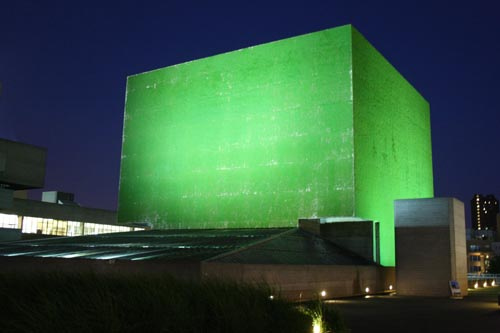
Pic: Lyttelton Flytower by Ackroyd and Harvey

(Crosspost from AAB) more ...

Saturday, 16 January 2010

changing state of the arts

There were plenty of good contributions at the first-ever State of the Arts conference this week, which was attended by more than 500 people.

There's the Guardian's report of Jeremy Hunt's speech here; and you can read the RSA's chief executive Matthew Taylor blogging here, Andy Field's speech here, Marcus Romer's slide show here, Jack Hutchinson's tweets here, and a pdf of all the day's tweets here. [Update: Charlotte Higgins blogs in the Guardian about the Tory arts proposals and the Arts Council's Mark Robinson gives his take on ArtsCounselling. 18 Jan.]

Quite a few people spoke about the changing dynamic between artists and audiences (more hybrid, immersive, interactive and cumulative). But the event itself demonstrated very little of that shift.

The organisers have asked for feedback. First off, it was a very rewarding event. Well worth doing again. A number of people have said that if there's one next year, it should be outside London. This blog would also add:

- distribute some key speeches in advance, so some sessions become Q&As.

- cut promo films from TV execs

- encourage chairs to frame each session, pursue key points, and insist contributions are brief and focussed

- livestream main sessions

- take more questions from audience (but no speeches)

- keep intros to minimum (we have the biogs)

- get panellists to interact earlier

- appoint moderator for whole day to draw themes together

- make Wi-Fi available everywhere

- encourage online debate in days before conference

- take questions from Twitter


The anthropologist Grant McCracken blogged usefully a couple of years ago about reinventing the conference.

Our world has been decentered, flattened, destabilized, distributed, and made participative, anarchical, elite indifferent, cloudily networked, self organizing, and concatenating. So it’s natural that we’re having to rethink entertainment, information, elites, experts and especially speakers. Who now wants to sit in a room and hear someone hold forth?

This weekend's conference Science Online 2010 went a lot further down this road. more ...

Friday, 13 November 2009

blogged

Over at the RSA's Arts and Ecology blog, there's a write-up about Wednesday's interview in Cambridge with Steve Waters. more ...

Monday, 14 September 2009

love in a green climate

The TV writer Jennifer Cowan's first novel Earthgirl ("Ages 14 and up") has a 16-year old heroine, Sabine, who turns into an eco-warrior.

In an interview earlier this year, the author discussed her take on Young Adult fiction:

I found that books that were issue-oriented seemed heavy handed, and books that were fun and chatty were frivolous and at times a bit morally bankrupt.

Cowan set out to do a chatty book - there are lots of blog entries with genuine urls - that was also a morality struggle. Online, Earthgirl continues to blog and to tweet. There's a Facebook page too.

Earthgirl is a book about love, friendship and the environment and how these three can clash. In yesterday's New York Times, the critic Regina Marler writes

I remember college friends discovering the animal rights movement; they described suddenly perceiving a layer of cruelty under everything around them.

This is Sabine’s awakening, subtly and thoroughly explored by the author. Sabine begins to realize the rippling social and ecological effects of her smallest choices: an exhilarating but exhausting process, during which she loses her two best friends.
more ...

Wednesday, 8 April 2009

print off

The Ecologist abandons print. more ...

Tuesday, 17 March 2009

radicals get it, pragmatists don't

Plenty of other blogs have linked to this piece by Clay Shirky about newspapers and the internet, and how it compares to the invention of Gutenberg's printing press, and where we might go from here.

Money quote:

'Revolutions create a curious inversion of perception. In ordinary times, people who do no more than describe the world around them are seen as pragmatists, while those who imagine fabulous alternative futures are viewed as radicals.' more ...

Sunday, 8 March 2009

tweeting mozart

Blogs, Facebook, Twitter: there are many new forms of arts coverage that can bypass mainstream media.

I've done a piece for More Intelligent Life about my 12-hour backstage twitter of the WNO's Marriage of Figaro. more ...

Tuesday, 24 February 2009

tweeting mozart

Tomorrow this blogger is away in Cardiff reporting on 12 hours in the life of the Welsh National Opera (see below) as it presents its new production of Marriage of Figaro.

Regular tweets from noon to midnight will be appearing here. They'll be in English and Welsh.

This could be the first bilingual twitter about the arts. more ...

Sunday, 15 February 2009

a three-day tweet

There'll be no posts on this blog on Monday, Tuesday and Wednesday, but you can follow ashdenizen tweets during that time at www.twitter.com/ashdenizen. more ...

'the only website... such focussed digital excellence'

From Theatre Ecology - Environments and Performance Events by Baz Kershaw (CUP, 2007):

'So by the early 21st century an international movement of environmental and ecological creative performance groups was emerging to span a plethora of forms, genres, aesthetics, venues, locations, sites, purposes, policies and, last but not least, pleasures.'

'A visit to the only website currently wholly dedicated to theatre/performance and environment/ecology gives an excellent idea of this from a UK perspective. The Ashden Directory combines magazine and database formats.'

'The directory lists more than 50 companies, and 200 productions that have serious ecological intent with links to relevant websites, many of which are wonderfully informative and/or imaginative in structure and content. Here is a 'field' that would take at least half a dozen books to explore properly and it is no doubt variously replicated in many parts of the world, though not with such focused digital elegance.' more ...

Saturday, 14 February 2009

tweets

Ashdenizen is now on twitter. Go to www.twitter.com/ashdenizen. more ...

Wednesday, 21 January 2009

the number of doors we can open

'There is no limit to what we can show online'
- says the NT's director Nicholas Hytner, in a longish piece I've done for Intelligent Life -
'the number of doors we can open, the number of walls we can bring down.' more ...

Friday, 21 November 2008

missing link

As soon as I read Ian McEwan's piece on Barack Obama, climate change and global poverty, I wondered if Arts and Letters Daily would link to it.

Arts and Letters is the aggregator website that links to many of the most interesting articles that appear online (it has even linked to one of mine). The site's motto is veritas odit moras (truth hates delay). The McEwan piece would seem a natural link.

Here is one of our leading novelists writing about the most pressing issue of the day. The subject is central to his new novel. McEwan is well-informed. The article is excellent.

But there are some truths that editors like more than others. As long-term users of the site know, Arts and Letters doesn't like stuff that sounds at all green. It much prefers the stuff that's boisterously anti-green.

So whatever the Latin tag says about truth and delay, it may not be the place to find a link to McEwan's urgent and elegant article. more ...

Monday, 10 November 2008

beyond the soundbite

'Even in the age of YouTube and the soundbite,' says the Sunday Times, 'Barack Obama has proved that soaring, sustained oratory still has great power.' Nice, that 'even'.

YouTube was a huge contributing factor. It allowed the public to listen to far more of Obama's speeches at far greater length than any TV network would have allowed. YouTube worked against the soundbite culture. more ...

Sunday, 9 November 2008

job creation

Seth Godin recommends three new jobs that any online company needs to fill. It might equally apply to theatre companies. 1) Community organiser. 2) Stats fiend. 3) Manager of freelancers. more ...

Saturday, 8 November 2008

clips win

People spent 14.5 million hours watching Obama on YouTube. That kind of TV exposure would have cost $47 million, half of what the McCain campaign spent in total. more ...

generation ahead

McCain's chief strategist Steve Schmidt says viral information is now as important as network news. The Democrats were 'a generation ahead'.

Each party develops techniques, usually when they’re out of power, for the purpose of gaining power on the next election — need being the mother of all inventions. You saw Republicans pioneer direct mail in an earlier age. You saw, you know, the use of television advertising pioneered in an earlier age. You saw microtargeting—you know, the overlaying of consumer and consumer data against the voter file, earlier in the decade, to much effect. There’s been a profound leap forward in technology and from a community organizing perspective by the Obama campaign in this election. The Democratic Party is a generation ahead technologically. And the Republican Party is going to have to be competitive to catch up in a world where viral information is just as important as what might be in the network news.
more ...

Friday, 18 July 2008

from war to web

'The best Ayckbourn play Alan Ayckbourn never wrote.' (From review of The Female of the Species here.)

The Germaine Greer-ish character is Margot, played by Eileen Atkins (left). Margot says the answer to so many questions these days – Where did you meet? Why did you break up? – is 'the internet'.

Sixty years ago, she says, it would have been 'the war'. more ...

Monday, 16 June 2008

next billion

Two takes over the w/e on the cultural impact of the internet. Jimmy Wales, founder of Wikipedia, says,

'If you think the internet has transformed the way we live, the way we work and - crucially - the way we learn about the world, imagine what happens ... when the next billion people come online, as will happen in the next five or 10 years ... What an extraordinary wealth of local knowledge they will bring.' [Article appeared in yesterday's Observer, but not yet online.]

Tyler Cowen, economics prof and Marginal Revolution blogger, gave a talk on Saturday (blogged at Arts Admin) saying the last five years have seen more changes to the way we consume culture than at any other period. Will these changes kill the performing arts? He doesn't think so. At the end the day, people still want to go out. more ...