Showing posts with label theatre. Show all posts

Tuesday, 11 December 2012

The tide could turn with 'Ten Billion'

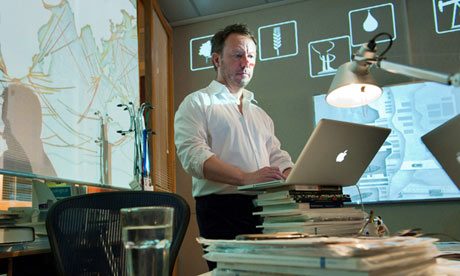
Stephen Emmott in Ten Billion
Wallace Heim writes:

Theatre critic Kate Abbott in today's Guardian joins Michael Billington in reporting a life-changing experience watching Ten Billion at the Royal Court.

Like the facts that Stephen Emmott presented, Abbott can recite the well-polished instructions to "help us out of this hole":

"Never buying a car, iPod, or cotton T-shirt again … stopping our addiction to fossil fuels, starting a mass-desalination programme, building green energy power points on every strip of land, harnessing every scrap of wind, and every turn of the tide …"

But one change is missing. What about demanding that theatre itself changes? What about demanding that mainstream theatre no longer turns away from the compelling emotional, moral and intellectual questions of how humans can continue to live in a time of climate instability? Theatre is more than science, more than facts, more than an instruction manual. What about demanding that theatre takes on its full life-changing role, somewhere between fiction and fact, and becomes the place where audiences wrestle with their future?

See 'Ten Billion' from another side.
more ...

Friday, 7 December 2012

'Ten Billion' from another side

Wallace Heim writes:

Michael Billington, in his nomination of Ten Billion as the best theatre event of 2012, claims that all the people he knows who saw the production found it life-changing. From my unscientific poll of the dozen people I know who saw the production, including myself, it’s possible we were in a different theatre. The lecture was well-crafted, the production tight, but the event was neither moving, informative or motivating. It was ‘old news’, a ‘first-year introductory lecture’, ‘Al Gore without the cherry picker’.

Billington’s lauding of the production is encouraging. That he, and others, were deeply affected is even more so, although one wonders what he has avoided reading or seeing for the past 20 years if the information presented was shocking. But Billington finds that it is not merely the accumulation of statistics, but the presence - the performance - of Stephen Emmott, the verifiable scientist, the speaker with a creditable reputation outside the theatre, that gave the production its urgency.

For this audience, the fluid realm of belief and disbelief that makes theatre work had to break down for the shock of climate instability to be heard. At the same time, the very theatrical occasion of sitting in that darkened room redolent of emotions of past productions, listening to another human speak, heightened any effect.

Asking again of those who found the production lacking, I found each person had, in their experience outside the theatre, at least one, if not many moments when the numbers add up, when the terror hits, when someone trusted speaks about a future irreconcilable with what one could bear. These events can be motivating and if Ten Billion provided that for some, then theatre’s role as educator has been met.

But if you’ve already had that experience, theatre is where you want to go to understand it, and a collocation of facts will not do that. This is a far more confused territory, requiring human imagination and many avenues of intelligence, deliberation, conflict and consent. It requires doing something like the processes of science, itself – its questioning and cross-questioning, experimentation, doubt and informed agreement.

Theatre may not be the place to present firm courses of action; Emmott’s advice to get a gun falls especially short. Conventional forms of theatre may, or may not, be adequate to the combination of reality and fiction that understanding climate change demands. But theatre, or something like it, continues to be a place where collectively, humans find a way through. There will continue to be many kinds of productions for many kinds of audiences. The hunger for a theatre by the audience that gets the facts but wants more continues to be strong. 
more ...

Thursday, 6 December 2012

'Ten Billion' changes Billington

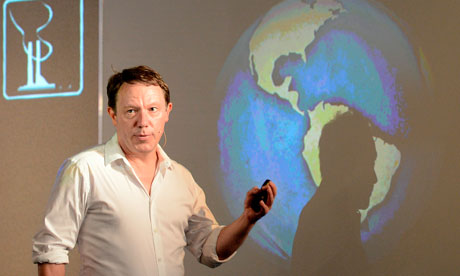
Stephen Emmott in Ten Billion
Wallace Heim writes:

Michael Billington in today's Guardian nominates Ten Billion as the 'most momentous theatrical performance' of 2012. The show was a lecture by Stephen Emmott, at the Royal Court Theatre Upstairs, on the consequences of human overpopulation and climate change.

Billington writes:

'I came out shaking with fear, but also moved by theatre's capacity to confront the emergency facing our planet.

'This was theatre doing what it does best: confronting us with unpalatable facts about our very existence. This doesn't mean that there is no room for invented stories or that King Lear and The Lion King have suddenly become redundant. But Ten Billion, directed by Katie Mitchell, shocked us into a new awareness of the future, and even the existing present, with ecosystems being destroyed, the atmosphere polluted, temperatures rising and a billion people facing water shortages.

'I don't know a single person who saw it who didn't feel it was a life-changing experience. If enough people, especially those in positions of power, could see Emmott's lecture, it might, just might, help to save our planet from destruction'.
more ...

Friday, 5 October 2012

the family and the world heat up in Nick Payne's play

Photo: Joan Marcus
Kellie Gutman writes:

If There Is I Haven't Found it Yet, with Brian O'Byrne and Jake Gyllenhaal, opened in New York's Roundabout Theatre in September and runs through 25 November.  It was written by Nick Payne, and inspired by his reading of Heat by George Monbiot, about decreasing one's carbon footprint.  Payne saw that many authors of environmentally-themed books had dedicated them to their children, and it gave him the idea of a father trying to save the planet in order to make the world a better place for his children, and beyond.  But the father is so wrapped up in his work that he fails to notice the problems within his own family.  The New York Times review is here.

Artistic director Todd Haimes writes:

On one level, we are watching a domestic drama play about a mother, father, daughter, and uncle.  But the play also takes on a much bigger global issue.  We all want to do the right thing for both the world at large and for the world of our own family, but maybe that's impossible.

More George Monbiot on ashdenizen:
roundheads and cavaliers
the negotiator and the polemicist
vanishing act
George Monbiot finds Dr. Faustus the classic text for climate change
more ...