Showing posts with label finite resources. Show all posts

Sunday, 13 March 2011

economist wonders if hunter-gatherers got it right

Monik Gupta has translated posts from ashdenizen for Oeko Fakt. In this guest post, Monik links our blog about Heart of Darkness with research at the Max Planck Institute.

The recent post about Conrad's Heart of Darkness, and its central theme of consumption of resources in the world, resonates strongly in the German broadsheet Süddeutsche Zeitung.

Astrid Matthey, a scholar at the Max Planck Institute for Economics, questions the widely-held belief that increased wealth and prosperity is closely related to increased well-being, citing research which fails to show such a relationship both in industrial as well as currently developing countries.

"We can no longer afford to leave it to each individual whether to say 'no thanks' in a society focused on consumption; simply because saying 'no thanks' is so incredibly hard for the homo relativus as long as consumption is the measure of all things ... it doesn't allow for the degree to which our current lifestyle threatens the global provision of resources and world peace."

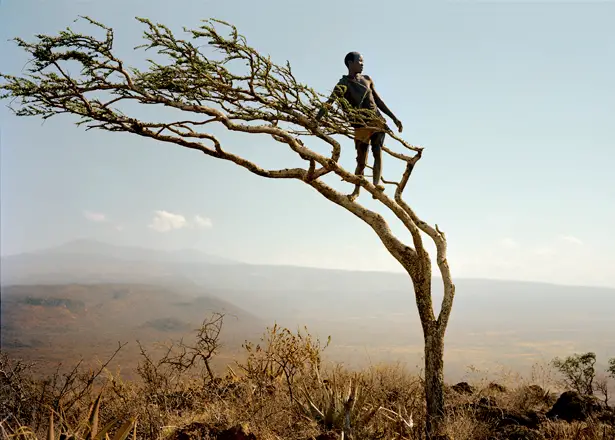
"National Geographic reports on a community of hunter-gatherers in Africa (pic), who happily spend a major part of the day with leisure time, instead of 'striving for more'. Concluding, the author asks: 'What do they know, which we have forgotten?'"

See German version of post about climate change jokes
The other post that's been translated into German is about two very different plays about climate change. There's no exact translation, Monik says, for the English expression "about bloody time", so he went for the politer Das wird aber auch langsam Zeit.
more ...
Wednesday, 26 January 2011

conrad's heart of darkness: the most influential 100 pages of 20th century

As Heart of Darkness has moved from one medium to another, it has made a good claim to be the single most influential hundred pages of the 20th century. If you consider its central theme—how one half of the world consumes resources at the expense of the other half—it’s easy to see its relevance becoming even greater. Only the resources will no longer be ivory for piano keys, or rubber for bicycle tyres.

My 'Going Green' column on Conrad's novella appears in Intelligent Life.
more ...

Wednesday, 29 September 2010

blogging about the new oil

This blog is one of more than 900 that have signed up to join Blog Action Day.

On October 15 each blog will write about 'water'. Last year the topic was 'climate change' - 13,606 bloggers from 156 countries joined in the conversation.

Mary Robinson has said 'water is the oil of the 21st century, and waste is the gold.' So the topic, really, is the new oil. more ...

Sunday, 26 September 2010

where do your interests end?

After Hillary Clinton's announcement last week of $50 million for clean cookstoves, one New York Times reader wrote on the Dot Earth blog (comment 6)that he didn't think Americans had a moral obligation towards people living in other countries.

Dot Earth's Andrew Revkin replied

This is one of the fundamental issues of our time: Figuring out where borders of various kinds end. When your pants are made in Bangladesh, your cellphone components require minerals from gorilla habitat in Congo, your next deadly flu threat comes from a poultry/pig farm in China and your (and China’s) emissions (slowly) influence the climate and coastal future around the world, where do your interests — and responsibilities — end?
more ...

Sunday, 4 July 2010

giant day in tooting


 A town in transition. Trashcatchers' blog. ITV's London Tonight.

Type rest of the post here


more ...

Wednesday, 30 June 2010

only connect

Who would have guessed it? The paper that published the winner of One World Media's journalism award for increasing 'global understanding through effective use of the media' was the Mail on Sunday. One World Media is a UK-based charity that highlights development issues, and promotes democracy and fair government worldwide. The winner was Dan McDougall (left).

Jonathan Freedland, Guardian columnist and one of the judges, writes today about McDougall's three 'blistering reports' for the Mail on Sunday, which all focus on the world's extractive industries:

One showed the consequences of our ravenous appetite for lithium, the mineral used to power our iPods and BlackBerrys: those living around Chile's largest lithium mine are parched, as their water is either poisoned or diverted.

McDougall produced similarly eye-popping pieces on the Madagascan mines where the nickel for our coins comes from, and on the badlands of eastern Zimbabwe, where virtual slaves dig for diamonds, jewels that will eventually find their way here.


Freedland notes:

All these reports made the connection between apparently remote suffering and our own lives.

photo: frontlineclub more ...

Thursday, 11 February 2010

rack the value

Pavan Sukhdev argues that the economic invisibility of nature in our dominant economic model is both a symptom and a root cause of the rapid decline in biodiversity and ecosystems. We value, he says, what we price.

If Shakespeare is right, though, whatever price we put on nature now, we'll have been prepared to have put an even higher price when it's gone. As the Friar points out (a little sententiously) in Much Ado About Nothing:

what we have we prize not to the worth
Whiles we enjoy it; but being lacked and lost,
Why, then we rack the value.
more ...

Monday, 8 February 2010

timely indictment

When the National's artistic director Nicholas Hytner announced the latest season, he said that playwright Mike Bartlett's new play Earthquakes was:

a timely indictment from a writer who is genuinely of the young generation at the generation older than him who he accuses - I’d say with some justification - of a form of debauchery. more ...

Saturday, 5 December 2009

'surely unconscionable'

The Daily Telegraph carries a fair number of climate-sceptic columnists who are happy to advertise their lack of interest in science. Today one columnist writes: 'I have not so much as an O-level in physics or chemistry. All I do know is this ...'.

Another columnist writes grandly: 'And although I do not believe in climate-change catastrophe theory ...' as if it were a question of personal taste, like whether he preferred to take his holidays in Tuscany or the south of France.

But the paper's leading article today on Copenhagen is more thoughtful than you might expect from the articles that surround it:

Many of the proposals would be the right thing to do even without climate change: it is surely unconscionable, for example, for the current occupants of the Earth simply to continue extracting and exploiting a finite resource – such as fossil fuel – to the point of its depletion. more ...

Wednesday, 28 October 2009

ever decreasing circles

The US Department of Defense, or DOD, consumes more energy than Bangladesh and Bangladesh has a population of 162 million. Yet one of the major roles of the US military is to protect US energy supplies.

Let's think this through: if the military wasn't quite so large, the country wouldn't need quite so much energy, which would mean the military wouldn't have to be quite so large, which would mean ... more ...

Sunday, 6 September 2009

coal's enduring claim to fame

A few weeks ago, I suggested to a friend that it would be impossible for a revival of one of D. H. Lawrence's plays to have the same impact today that it did when Peter Gill directed A Collier's Friday Night, The Daughter-in-Law and The Widowing of Mrs Holroyd at the Royal Court in 1968. An audience now might well look at the whole business of coal-mining in an ironic light.

This month the BFI presents a series of movies about coal. In yesterday's Guardian, Ian Jack perfectly summarises the change in our attitude that has taken place:

Until the 1990s the history of the British coal industry could be seen in different ways – socially (greyhounds, comradeship), sentimentally (granddad), politically (struggle and strikes), geologically, economically, even aesthetically.

But from a far higher elevation, perhaps that of eternity, all these interpretations will seem like whisperings in Lilliput. The coal industry's most enduring claim to fame, should history endure, is its vanguard position among the causes of global warming.
more ...

Monday, 6 July 2009

what the new narrative describes

The founder of the Eden Project, Tim Smit (left) elaborates on what he means by 'hippy shit'. He says he in no way meant:

'to decry the efforts of those who are encouraging the first steps in community action through various mediums such as growing your own and so on, merely that we have been here before many times and the danger of becoming over impressed with such steps is that it drowns out the scream from the future that a truly radical shift in philosophy and leadership is required - one that questions the fundamentals of the way we do business, measure growth and take on responsibilities as citizens as opposed to just being aware of our rights.'

The target is to cut our carbon footprint by 80%. To succeed in doing this:

'we need a new narrative, one that describes the sunny uplands our society is striving to reach and the reason why adopting a philosophy which sees us recognising our part in and responsibility to the natural world will see us working with the grain of nature and not against it.' more ...

Thursday, 2 July 2009

tim smit defines 'hippy shit'

There was a conference yesterday, organised by the Sustainable Development Commission, on Breakthrough Ideas For the 21st Century.

William Shaw at the RSA's Arts and Ecology blogs about attending one session and a new sense of frustration that's creeping in:

'The morning rolled on and we heard about an idea to teach happiness in schools, a(nother) website for joining up activists of all hues, an idea to persuade to schools to take children to the countryside so they could get in touch with the natural world, etc.'

At the end of this well-meaning hour of discussion the Eden Project's Tim Smit stood up and said this is 'hippy shit'.

What did he mean by this? There wasn't time to discover. But someone has left a link below Shaw's blog to a 2007 Guardian article by Smit which gives a very good idea of what he means. Smit writes:

'Last year I spoke at the 40th anniversary of Resurgence magazine, and asked the audience if they believed that everybody on Earth should have access to clean drinking water. They all put their hands up. I asked them who supported WaterAid, a fabulous charity, and almost everybody put their hands up. Then I asked who believed WaterAid could provide clean drinking water to everybody on Earth. Nobody put their hands up. I laid into the audience. I said: "The problem is you're in love with hippie shit."'

However terrific the charity, the scale of the problem is too big. Smit believes that some of the biggest businesses in the world - in energy, water, railways - should be run as social enterprises. more ...

Wednesday, 1 July 2009

that was the year that was

Which was the most important year in history? Andrew Marr nominated 1776. This blogger has jumped in and argued for 1712. more ...

Friday, 26 June 2009

the minister's bedside book

The Energy and Climate Change minister Ed Miliband was live-blogging at the Guardian this morning. One questioner asked about David Mackay's new book Sustainable Energy - Without The Hot Air. Miliband replied:

'MacKay's a smart guy. His book is by my bedside and my permanent secretary keeps telling me I have to finish it!'


Keep reading, Ed.

(My article about MacKay's book says: 'It's geek heaven: full of killer stats that you immediately want to pass on'.) more ...

Monday, 18 May 2009

know hope

'While I have yet to be convinced that man’s 3% contribution to the planet’s greenhouse gases affects the climate, I do recognise that oil is a finite resource and that as it becomes more scarce, the political ramifications could well be dire. I therefore absolutely accept the urgent need for alternative fuels.'

Jeremy Clarkson more ...

Sunday, 17 May 2009

nice work

New Yorker film critic Anthony Lane spots an anachronism, or more specifically a parachronism (OED: 'too late a date'), in the new Star Trek.

There's a scene in the movie, which introduces us to Captain Kirk's childhood and early adulthood, where the youthful James trashes a red Corvette.

'Nice work, Jim,' writes Lane, 'getting hold of fossil fuel in the twenty-third century'. more ...

Thursday, 7 May 2009

vanishing act

George Monbiot has called Cormac McCarthy's The Road the most important environmental book ever written.

That's one reason why Benjamin Morris and Bradon Smith, who run CRASSH's 'Cultures and Climate Change' programme, chose this widely-acclaimed novel as the subject for an excellent seminar.

The afternoon's discussion fell into two parts: text and context. The discussion about text ranged from the paradox of a rich vocabulary conjuring a bleak and ashen world, through to post-apocalyptic ethics and the theme of redemption.

In discussing context, and how the book was received, there was a difference between its reception in the US - where its Biblical and lapidary cadences were noted by critics - and its reception in the UK, which has been somewhat skewed by Monbiot's striking claims. He also nominated McCarthy as one of the 50 people who could save the planet because The Road shows that 'everything we value depends on the ecosystem.'

That is, of course, irrefutable: no food, no civilisation. But McCarthy never says what has caused the devastation, so there's no sense of cause and effect. It might even have been an asteroid. All we know is that the biosphere is dead and the survivors have been eating tinned food (at best) and each other (at worst).

A novel about climate change, one that imagines a future that's been brought about by rising levels of CO2, would still show large parts of the biosphere surviving. One ecosytem would have replaced another. As James Lovelock keeps reminding us, it's the millions and millions of humans who would have vanished.

(A summary of the seminar will appear shortly on the RSA's Arts and Ecology website.)

pic: Kodi Smit-McPhee and Viggo Mortensen in The Road (to be released October 2009) more ...

Wednesday, 1 April 2009

scudding cloudcuckooland

Cloudcuckooland (pic) is a loose adaptation of Aristophanes' The Birds. It takes the idea that there are 27 times as many birds as there are humans, so if birds revolted against humans for trashing the planet, the birds might win. The secret weapon the birds employ, as they launch attacks on major cities across the world, is bird poo. (Tour dates here.)

Last week, Cloudcuckooland's producer Helen Eastman wrote a message on the internal email for SCUDD (Standing Conference of University Drama Departments) outlining the show's environmental credentials:

'We send the cast everywhere by train rather than driving them, and we offset all our flights. The show has a lot of props, so we have to be certain that they are all kind to the environment ... We've got a brilliant cast and crew, and we always get fantastic feedback from kids and their parents. I think that's why everyone's prepared to go the extra mile to practice what the show preaches.'

This led to a good exchange. Steve Bottoms, from Leeds University, took exception to this 'self-aggrandising publicity fluff', writing back:

'The fact is that theatre -- like very much else in our everyday experience of the world -- is an inherently carbon-emitting activity, and we need to face up to this rather than pretend that "the creation of a completely sustainable touring model" is this easily achievable.'

Helen Eastman replied, saying 'fair comment, but you have to start somewhere'. Eastman went on:

'When we took this show to Edinburgh last summer, we discovered that the festival (unlike most music festivals etc) had no environmental policy on its website, no attempt to get people (audiences or companies) to share transport to get there, no policy for recycling the millions of fliers handed out in the streets.'

Franc Chamberlain, from Cork University, joined the debate:

'There are people on this list [SCUDD] who've been engaged in environmental politics and trying to be environmentally aware for over thirty years. if you're serious about raising the awareness of some festival organisers, then band together with other interested companies to force change and simply don't go if the festival organisers aren't prepared to make changes. There are plenty of other festivals that are concerned about environmental issues.'

Gareth Somers, from Portsmouth University, took the challenge to another level. Leaving aside the specifics of Cloudcuckooland, he wrote to point out that many people on the SCUDD list:

'question the value (in ecological terms) of a humanist theatre that supports anthropocentric values. In this light sustainability might be viewed as green-washing - Is a theatre that exploits the "natural world" as metaphorical resource to discuss human centered issues, in itself an ecologically positive force - whether the production be sustainable or not?' more ...

Wednesday, 25 March 2009

tasteless weddings

Two tweets from Stephen Fry in Malaysia (he says he's here):

Tragedy is sharks fin is completely tasteless - soup has to be flavoured with chicken stock. Such a shame.

about 9 hours ago

150 million sharks killed a year. It's devastation. Almost entirely for the fins. Chinese weddings traditionally serve the soup.

about 9 hours ago


(Closer to home: this blogger is tweeting Salome in Birmingham this evening with Erika Sunnegårdh as Salome. The tweets will appear here. A piece about tweeting Mozart appears here.) more ...