Friday, 3 June 2011

climate playwright tackles free schools

As any regular reader of this blog knows, the playwright Steve Waters has written the best play about climate change. After The Contingency Plan, he went on to write Little Platoons, a play about free schools.

The radio version of Little Platoons is broadcast with the original cast tomorrow afternoon at 2.30pm.
more ...

Wednesday, 1 June 2011

new on our newspage

Artsadmin’s Two Degrees 2011 Festival, Art & Activism, Climate & Cuts, runs from 12 – 18 June in London, with artist-led interventions and events on the themes of government cuts, global protest and activism, and the growth of alternative solutions to the climate crisis. There’s the chance to eat American Signal Crayfish caught from the River Thames, a trail of bicycling events between Artsadmin’s Toynbee Studios and Arcola Theatre, and other events, films, excursions, including A Good Climate for Business, Future Editions, Potion, Haircut Before the Party, Paths Through Utopias.

Our Current Climate, 18 June, closes Two Degrees with a day of talks, workshops, performances, interventions and walks with artists from the festival and Encounters, UK Uncut and the Yes Men.
The event will be asking how exactly are the climate and the funding cuts linked, and how can we use art and activism to change our current climate?

Manchester International Festival has two different events touching on the environment, Björk’s Biophilia show, and the launch of a three-year project to construct a vertical farm in a disused tower block.

We list those summer music festivals that have environmental themes, or are working towards a low-carbon event.

New productions coming up in June include Harmonic Fields (Lakes Alive), As the World Tipped (Nigel Jamieson and Wired Aerial Theatre, a TippingPoint/Without Walls commission) and SEVEN ANGELS (The Opera Group, ROH2 and Tramway).

Other events: University of the Trees holds an Open Day on 5 June, and a public talk by Shelley Sacks on 11 June at the Centre for Contemporary Art and the Natural World, Devon.
more ...

Tuesday, 31 May 2011

makes you gulp, makes you think

The Stage reviews As The World Tipped, one of the winners of this year's TippingPoint commissions. The reviewer, Mark Shenton, says the show is very timely indeed.

"Part very physical performance and part film, as aerial acrobats are suspended and crawl over a giant vertical screen that the stage becomes, and are dwarfed by the huge filmed images projected around them, this outdoor show is a lot more than mere spectacle. It does that rare thing - it makes you gulp with astonishment, but also think."


Five-minute YouTube clip here.
more ...

Wednesday, 25 May 2011

what type of French person isn't going green?

The French paper Libération runs a piece today on les écolo-résistants who worry more about their car than the planet. Libération assesses the écolo-résistant type in terms of age, sex and income. The answers are: "50-65 ans environ ... Homme ... Hauts revenus." more ...

Monday, 16 May 2011

bottom gear

In a recent column Top Gear presenter Jeremy Clarkson appears to be envying the life of the forager.

"If you do lose your job and you end up living in a barn, with just a fire to keep you warm and nothing to eat but what you can find in a hedge, be happy. Because you'll be having a much better life than me." more ...

Wednesday, 11 May 2011

new metaphors for sustainability would need to range from "resilience" and "symbiosis" to "anxiety"

In the second of her two reports from the Staging Sustainability conference in Canada, Wallace Heim reports on the reactions to our latest project: "New Metaphors for Sustainability"

Staging Sustainability also marked the launch of Ashdenizen’s and the Ashden Directory’s project to find new metaphors for sustainability, with the first showing to an audience of our online DVD ‘By Another Name’. The video is of four people suggesting four very different metaphors for sustainability and is the first stage of our project. Over the next weeks, we will be asking many more people, and presenting their responses here and on the Directory.

Clockwise from upper left: Carolyn Steele, Zoë Svendsen, Ansuman Biswas,  James Marriott

At the conference, the video was looped for the duration of the first day and I showed it in a panel session on the second day. Fortuitously, there was a generous amount of time. I opted for a conversation with the people there rather than the paper I had prepared – and that was a much more interesting turn.

The prospect of finding a metaphor for sustainability was challenging. No impromptu metaphors were suggested, instead, there was discussion about what it meant to ask the question. Conceptualising it in that way goes against the habitual languages of accountancy, management and measurement. There was resistance from some to considering sustainability as anything other than a hollow idea bereft of novelty, motivation or consistency.

More people, though, enjoyed the problem and whether sustainability as a concept could be revitalised. The combination of metaphor and sustainability was intriguing, a chance to draw out buried emotional and psychological aspects. For one person, trying to live sustainably in rural Canada, the effort is one filled with anxiety, uncertainty as to his survival, and his metaphor would have to express that. For others, it made more sense to think of metaphors for ‘resilience’ or 'symbiosis'. Another contribution brought out the importance of ‘deep’ metaphors to one’s world view and sense of meaning, and the effects of not having, or losing those metaphors. Could a metaphor for sustainability be a 'deep' metaphor? There was talk of when ‘nature’ is a metaphor, and when it is not, on the stage, in the garden and in everyday life.

It was a good start. Special thanks to Barbara Sellers-Young, the conference co-organiser, who was generous in her support for the project and the video.
more ...

Wednesday, 4 May 2011

conference on 'staging sustainability' suggests another theatre database to complement this one

In the first of two reports from the 'Staging Sustainability' conference at York University in Toronto, Wallace Heim finds herself sustained by some "intriguing new developments" and the discovery that one of the talks was highlighting the Ashden Directory.

One only hears a fraction of the papers and presentations at a conference, and the rest are a blur of abstracts left in a dark room. Unexpected intersections sometimes light up, and the most surprising of these was meeting Lesley Delmenico from Grinnell College, Iowa at breakfast.

Lesley Delmenico was giving a paper on ‘theatre ecology’ at the same time as I was presenting our DVD, and a paper on our project New Metaphors for Sustainability. We didn't discuss our papers, the table was busy with people. Only later when someone directed her to me did the bells start ringing. About a third of her paper was on the Ashden Directory itself, and what an excellent database and resource it is. More than that, somehow, she had connected through or to Steve Waters with Robert’s interview, and with students had produced as theatre his single-play radio version of The Contingency Plan.

As a further project, she's going to suggest that students start compiling a database similar to our Directory for theatre productions in the United States and Canada. All this was in the context of her ideas of how the internet and media networks make possible the rapid dissemination of ideas and images that the environmental situation requires.

The presentations in the conference were a good indication of what's happening in Canada. Having been to many of these events, and organised a few, it's the repetitions that become noticeable, (...of the: 'we made costumes out of recycled materials', or ‘the local community was deeply engaged’ sort....) with a few spikes of intriguing new directions - like those on disability and what that means for perceptions of self-and-environment by artist Alicia Grace from the UK; on queering ecology, a plenary presentation by York academic Catriona Sandilands and dancer Michael J. Morris; and on a project that worked with native peoples on the west coast of Canada that saved some territory from clear-cutting when conventional forms of activism failed, by Nancy Bleck from Canada.

more ...

Wednesday, 27 April 2011

exhibition of '10 climate stories' misses out on the big narrative

In this guest post, Benjamin Morris reviews the Science Museum's latest exhibition Ten Climate Stories

Buried deep inside Ten Climate Stories, in a film detailing Sir Vivian Fuchs' 1955-58 Antarctic expedition, is a brief statement of profound, Zen-like wisdom. In describing the literal pitfalls of their travels, with a giant Sno-Cat (above) freshly fallen into a crevasse, Fuchs drily notes: “You have to see a tractor in a hole before you can decide how to get it out.”

The lesson is reflective of its context: so, too, must you understand an exhibition before you can decide to give it a name. Ten Climate Stories is worth the trip, but not for what it promises, ten different stories about the climate. Not so. The content of the exhibition can roughly be divided in half, between old 'stories' retold from existing collections in the gallery (such as the steam engines, the atom-splitter, and the rocket modules), and new stories based on artefacts which appear in the museum for the first time (such as Yao Lu's photographs and Thomas Thwaites' toaster). Overall, the exhibition is clearly laid out, with a variety of artefacts, media, and modes of presentation, and the path is linear enough to give a sense of coherence in time—no small order for an exhibition spanning nearly three hundred years in just ten fits.

But still, the title. More accurate would be a title reflecting the exhibition’s actual focus: Ten Consumption Stories, or Ten Energy Stories. Only a few of the ten exhibits address either the climate or climate change, which becomes in this drama a background player lurking in the wings, waiting for its entrance onstage—an entrance that, with everyone else already having played their part (the exploration and discovery of natural resources, the history of scientific pursuit, the surge of private, public, and corporate development, and the ongoing artistic and cultural response) scarcely suggests a happy ending. In some cases, such as the third 'story' (an early photograph of Earth from space), the reference is barely even implicit. It feels as though, trying to drum up additional interest for its brand-new climate change wing, the Science Museum has positioned the word 'climate' as the bait before the switch.

As disconcerting are the mixed political messages sprinkled throughout the exhibition. The opening text of the first panel lays it plain: “The Industrial Revolution of the 18th century demanded huge quantities of natural raw materials such as coal and iron ore,” the panel calmly notes, as though this were a bygone fact of an historical era. The curatorial attitude towards resource consumption, extraction, and exploitation over the centuries remains largely neutral, even as the stories of the exhibits they have selected—contributing to it, critiquing it, or inviting us to reimagine it—are anything but ambivalent to this process. Henry Ford's own distaste for the modern era is a perfect example, with the exhibit addressing the development of the motorcar noting that “Ford himself considered the repetitive production process 'terrifying,' yet it helped usher in a modern age of mass consumption.”

This studious neutrality is perhaps reflective of the exhibition's sponsorship, partly from Shell Oil, and the risks in curatorial tone the Museum may have had to limit. The sheer brevity of the panels, and their often yawning generality, leaves the question open. More disappointing than any possible sin of comission, however, are the sins of omission: the absence of any narrative of renewable or sustainable sources of energy anywhere in the hall. The closest the exhibition comes is the following non-statement before the atom splitter, a few feet away from Ford's motorcar: “[Burning] fossil fuels such as coal to generate electricity has long been under scrutiny and alternatives are being closely examined.” Not that any are named, especially those so obvious (and free) as sunlight, wind, or water, anything that might one day temper profit margins.

That said, certain elements are worth sustained attention. The digital models of the steam engines illustrating their action are excellent: clear and simple, building from the humble output of the atmospheric engine at the beginning of the hall into a powerful narrative of design innovation and efficiency by its end. And of the two categories, the 'new' stories are as a group effective, with Lu's subtle yet vivid photographs inviting a scrutiny that rewards, surprises, and ultimately provokes the viewer. Thwaites' celebrated toaster, moreover, built only from materials he mined and refined himself, earns its laurels: ambitious in its goals yet modest in tone and delightful in execution, it succeeds in playfully exposing the level of material dependency to which consumer society is now unwittingly yoked. (But still, here, a missed opportunity: “The tremendous worldwide mining and manufacturing industry required to create these products,” the panel tells us, “and the millions of years taken for the raw materials to form, aren't considered when we throw them away.” Nor, the point could have been made, when we choose to buy them in the first place.)

Jem Finer's Longplayer, a musical composition that is intended to play unbroken for a millennium—from 1999-2999—is perhaps the most compelling of the three. Sit with it long enough and the realisation dawns that the bright pings that penetrate its deep, sonorous bass rhythms resemble those infrequent yet urgent reminders pinpricking our environmental consciousness. Warnings of overconsumption, of tipping points, the onset of new disasters and the release of new, alarming indicators: each of these comes to mind amid the background hum of daily life and habits. But in our minds as in the hall, too easily they are dismissed or ignored, leaving us only with the rhythm of the bass coursing through our body as we sit, a rhythm that we continue to take for granted long after we have stood and walked away.

All told, Ten Climate Stories is worth seeing not for what the title promises but for what it delivers without broadcasting in advance: smaller moments that reveal much both about our relationship to the earth and its resources, and, crucially, about the way that museums and other institutions of knowledge tell those stories themselves. Like Edward Said's proverbial map, any narrative-based exhibition ultimately tells a story about itself as much as its objects. That the story this exhibition tells falls short of its own mark is to be lamented; that it manages to reward its audience despite its own intentions is a lesson from which museumgoers and museum alike could learn.

Benjamin Morris last reviewed Uncivilisation: The Dark Mountain Festival for Ashdenizen. His work appears or is forthcoming in The Rumpus, Horizon Review, and Dark Mountain vol. 2. Having recently completed a PhD in Archaeology at the University of Cambridge, he is now a researcher at the OpenSpace Centre for Geographical and Environmental Research at the Open University. 
more ...

Tuesday, 19 April 2011

the mythology of switching on a lightbulb

The decision to switch on a lightbulb is deeply rooted in a mythology which most of us don't even know we have absorbed.

The theologian Martin Palmer (4 mins in) on Toby Jones' BBC Radio 4 programme The Light Switch Project, broadcast today. more ...

Monday, 18 April 2011

james lovelock and john gray in conversation tonight

An annual event, the Artangel Longplayer Conversation brings together two cultural thinkers to engage in a conversation that's inspired by Jem Finer's Longplayer, a musical composition playing in real time across the millenium.

Tonight's two speakers are climate scientist James Lovelock, author of The Revenge of Gaia, and philosopher John Gray, author of Straw Dogs. The event is sold out. But it's possible to follow the conversation on a live feed. more ...

Wednesday, 13 April 2011

going green means noticing there's someone else in the room

My latest "Going Green" column picks up on how Mary Wollstonecraft (left), author of “A Vindication of the Rights of Woman”, explained what thinking was to her young daughter: it was about noticing there was someone else in the room.

For this reason, going green isn’t left-wing or right-wing. It isn’t a threat. It isn’t a conspiracy by scientists or a means of introducing socialism by the back door. It isn’t even anti anything much, except boorishness. (Though boorishness has many manifestations.) Its real enemy is not-thinking. If you poison the well, people can’t drink from it. If you overfish the ocean, you end up with no fish. If you burn coal, you warm the planet. more ...

Wednesday, 6 April 2011

what happens when you turn on a light switch?

A 2009 Tipping Point winner, The Light Switch Project, will be broadcast on Tuesday, 19 April, on BBC Radio 4, at 11 am.  The story follows the actor Toby Jones as he tries to figure out what happens when you flick that switch.

See also: what you are doing when you flick that switch
assessment of latest tipping point commissions
Tipping Point winners announced tonight
more ...

surest sign of spring in the US

The cherry blossoms are in full bloom in Washington, DC. This is the nation's signature sign of spring, and the city celebrates their arrival with a festival.  Up north in Boston, our editor, Kellie Gutman, spotted her first daffodil yesterday. Her postcard to the Padeia School, in Atlanta has been filled in with the date of April 5 and sent to them for their charting of the speed of spring's advance.

Meanwhile, in a recent comment, Robin Dally googles the number of people showing any interest in "the signs of winter".

See also:
Keeping an eye out for the first daffodil
Spring's progress
more ...

Friday, 25 March 2011

how much more interested are we in first signs of spring than first signs of winter? answer: 16 times

How much more interested are we in the first signs of spring than the first signs of winter? Here are the stats when you search on Google for the following phrases:

"Signs of spring" 1,120,000
"Sign of spring" 6,540,000
"Signs of summer" 893,000
"Sign of summer" 183,000
"Signs of fall" 344,000
"Sign of fall" 386,000
"Signs of autumn" 221,000
"Sign of autumn" 219,000
"Signs of winter" 136,000
"Sign of winter" 328,000

Add the "sign" and "signs" for each season (and combine the totals for "autumn" and "fall") and you get:

Spring 7,660,000
Summer 1,076,000
Fall/Autumn 1,170,000
Winter 464,000

The result? There is seven times more interest in spring than in summer. There is six and a half times more interest in spring than in autumn and there is a whopping 16.5 times more interest in the arrival of spring than the arrival of winter. more ...

Thursday, 24 March 2011

not all the science in hollywood movies is bad

In today's Material World, Quentin Cooper discusses Hollywood and science with David Kirby, Lecturer in Science Communication at Manchester University and author of Lab Coats in Hollywood (2011).

Their pick of the Hollywood movies where the science is actually quite good includes Contact, 2001: A Space Odyssey, A Beautiful Mind, Finding Nemo, Apollo 13 and The Right Stuff more ...

Tuesday, 22 March 2011

what you're doing when you flick the switch

At yesterday's TippingPoint Science Day, Professor Mark Maslin, director of the Environment Institute at UCL, used a vivid phrase to describe the action of switching on a lightbulb: "You are burning fossilised sunlight".
more ...

Monday, 21 March 2011

reading thoreau

Much of Thoreau’s work can be read as a kind of apologia for attuned idleness. more ...

Friday, 18 March 2011

happening events

In her review of the TV series Sarah Palin's Alaska, Janet Malcolm, author of Reading Chekhov, makes this general remark about the surreal aspect of TV reality series.

Something always seems a little off in reality television. You don’t believe that what you are seeing happened in the way it is shown to have happened, any more than you think that the man in the Magritte was born with an apple attached to his face. more ...

Thursday, 17 March 2011

online survey on the way performing artists travel in europe

On The Move is working with Julie’s Bicycle to create a guide to the environmentally sustainable movement of performing arts and artists in Europe. They have asked people to contribute to an online survey with ideas, experiences and contacts. more ...

Wednesday, 16 March 2011

workshop on history and climate

This blog is participating in a series of workshops entitled Cultural Spaces of Climate. The second workshop on "historising climate" takes place today at the Royal Geographical Society.

Topics range from "weather and climate in colonial Bombay" and "changing meanings of storm surges" to "the role of the Met Office in the coal shortages of 1947". More to follow. more ...

Tuesday, 15 March 2011

what canute shares with lemmings, ostriches and luddites (they've been terribly misunderstood)

King Canute (or Cnut) wasn't trying to show his followers that he had power over the waves, lemmings do not commit mass suicide, ostriches don't bury their heads in the sand - and Luddites weren't against new technology (they just wanted jobs). 
more ...

Sunday, 13 March 2011

economist wonders if hunter-gatherers got it right

Monik Gupta has translated posts from ashdenizen for Oeko Fakt. In this guest post, Monik links our blog about Heart of Darkness with research at the Max Planck Institute.

The recent post about Conrad's Heart of Darkness, and its central theme of consumption of resources in the world, resonates strongly in the German broadsheet Süddeutsche Zeitung.

Astrid Matthey, a scholar at the Max Planck Institute for Economics, questions the widely-held belief that increased wealth and prosperity is closely related to increased well-being, citing research which fails to show such a relationship both in industrial as well as currently developing countries.

"We can no longer afford to leave it to each individual whether to say 'no thanks' in a society focused on consumption; simply because saying 'no thanks' is so incredibly hard for the homo relativus as long as consumption is the measure of all things ... it doesn't allow for the degree to which our current lifestyle threatens the global provision of resources and world peace."

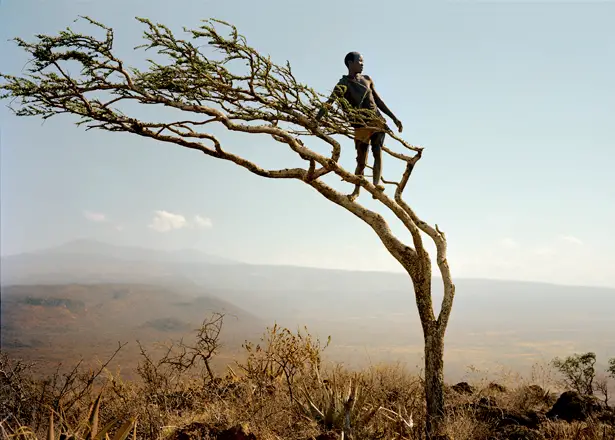
"National Geographic reports on a community of hunter-gatherers in Africa (pic), who happily spend a major part of the day with leisure time, instead of 'striving for more'. Concluding, the author asks: 'What do they know, which we have forgotten?'"

See German version of post about climate change jokes
The other post that's been translated into German is about two very different plays about climate change. There's no exact translation, Monik says, for the English expression "about bloody time", so he went for the politer Das wird aber auch langsam Zeit.
more ...

freedom of opinion as a farce

In his article on Rwanda, Stephen W Smith writes:

‘Freedom of opinion is a farce,’ Hannah Arendt wrote in 1966 in ‘Truth and Politics’, ‘unless factual information is guaranteed and the facts themselves are not in dispute.’ The problem with Rwanda is not only that opinions and facts have parted company but that opinion takes precedence.

Not just with Rwanda, with climate change too. more ...

Friday, 11 March 2011

a book that changed the world

It's not always easy to find examples of works of art or literature that have actually changed the world. But here's a good one.

In the week of the Oscars, Ban Ki-moon went to Hollywood to encourage writers and directors to write about climate change. In an online discussion afterwards on Climate Progress, the screenwriter Richard Brenne quoted the remark Abraham Lincoln made to Harriet Beecher Stowe, the author of the anti-slavery novel Uncle Tom's Cabin (1852).

Lincoln said: "Are you the little woman that started this great war?" more ...

Wednesday, 9 March 2011

spring's progress: from chiffchaffs in cheddar gorge to snow on the shady side of the street in boston

The view from Kellie's window on the sunny side of the street
The zoologist @lillashaw tweeted BBC Springwatch today to wonder when she would hear the first chiff-chaff of the year. Forget the frogs, the bees and the buds:

"for me that officially marks the arrival of #ukspring
This weekend, @lillashaw says in another tweet, she is off to Cheddar Gorge to listen out for any chiffchaffs:

"that's where I heard them first this time last yr :)"

Meanwhile, our America-based co-editor Kellie Gutman sends an update on spring's late arrival in Boston:

The Paideia School in Atlanta tracks the rate of spring's arrival all along the East Coast by plotting exactly when the first daffodil is seen all the way along the 2,377 miles Route 1. It has been getting postcards from spotters of the first daffodil since January. Last year my Boston postcard reported a daffodil on March 30th.

Spring is reaching us slowly. A Boston friend has seen a snowdrop in a neighbor's garden. The snowpack on my front lawn has now disappeared, although across the street, on the shady side, there are still large piles. Today the temperature is right where it should be; the buds on the apple trees along the fence are starting to form and the ground is beginning to thaw.

But students at Paideia should be warned: it will probably be April before the first daffodil appears on our street.

Last year we followed this project in the speed of spring, the melting snow and the results for 2010.
more ...

Tuesday, 8 March 2011

someone's doing nicely out of libya

The Financial Times reports today, on its "Markets & Investing" page, that

"The growing political crisis in Libya and the Middle East is driving huge gains for some of the world's largest commodity hedge funds ... Commodities in general have performed well for the past nine months, since agricultural prices began to rise ..."

In the Guardian, the economist Jayati Ghosh reminds us how closely oil and food are linked:

"Oil prices directly and indirectly enter into all other prices through higher fuel costs in production and transport. Agriculture is directly affected, so food prices will rise further, worsening the resurgent food crisis."

Huge gains, then, for hedge funds when oil goes up and food goes up. more ...

Monday, 7 March 2011

let's wait for the other facebook

The Facebook that's revealed in The Social Network is a fairly sour story of people trying to cash in on a privileged education. The Facebook that's revealed in the revolutions in North Africa is about democracy, freedom, courage and self-determination. Maybe one day someone will make a movie about that. It might win best picture. 
more ...

Wednesday, 2 March 2011

people get capitalism, they don't get sustainable development

Futerra has a useful series of tweets from the Big Sustainability Summit. One of the quotes, from Jonathan Porritt, was about what people needed to know about sustainable development, or SD.

Porritt said: 'SD doesn't need a headline - how many people really know what capitalism means?'

But there's a difference. People know what capitalism means because they experience it every day. They don't experience sustainable development every day. SD could do with some headlines. more ...

comedy doesn't have to float free

Wallace Heim responds to Nicholas Lezard's suggestion in the Guardian that Ian McEwan's novel "Solar" is hampered because you can't have a comedy about climate change:

It's curious that Nicholas Lezard (pic) thinks comedy floats free of the world. Comedy, classically, is quotidian. It is all about the everyday, the bumbling, ridiculous, faltering, sometimes obscene manifestations of the everyday, ordinary world. It is classical tragedy that is freer of the ordinary world. That's not to say in the intervening centuries the comedic and the tragic haven't changed, intertwined and adapted to each other and new situations, as they might again now. Maybe it is that the dark laughs in Solar are out of place, an old type of comedy that can't grasp the situation. more ...

Tuesday, 1 March 2011

the whoa-that-is-so-wow school of nature-writing

The New York speech writer Clark Whelton has written a smart piece about the linguistic virus that he calls vagueness. It opens with a lovely example:

I recently watched a television program in which a woman described a baby squirrel that she had found in her yard. “And he was like, you know, ‘Helloooo, what are you looking at?’ and stuff, and I’m like, you know, ‘Can I, like, pick you up?,’ and he goes, like, ‘Brrrp brrrp brrrp,’ and I’m like, you know, ‘Whoa, that is so wow!

Shelton writes, a little sternly, that the woman "never said anything specific about her encounter with the squirrel".

Meanwhile, for those who do like specifics in their nature-writing, Richard Mabey's new book is here and Robert Macfarlane's latest essay is here. more ...